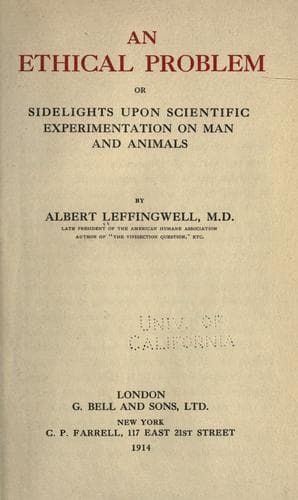
An ethical problem; or, Sidelights upon scientific experimentation on man and animalsLeffingwell, Albert
Philosophy
An ethical problem; or, Sidelights upon scientific experimentation on man and animals
Leffingwell, Albert
Medicine, Experimental; Vivisection
"Everyone who has followed this debate must be aware that the
resolution is ... entirely opposed to the facts elicited in the
discussion. Almost every speaker, except the veterinaries, put in a
protest more or less strong against the practice of surgical
operations in veterinary schools, and again and again was the word
ATROCIOUS applied to them. We learn, moreover, that this mode of
instruction was adopted in 1761, so that for more than a century these
atrocious operations have been practiced on animals in French
veterinary schools. Yet the Academy decides that complaints on this
score are without foundation, and that men of science in this matter
NEED NO INTERFERENCE! We may be sure that, however much the
Academicians may snub the affair, the discussion cannot fail to have
beneficial results."
Two or three weeks later, on October 10, the Journal again touches the
subject of physiological demonstrations, and denounces them--when
conducted as in Paris--as a scandal to humanity. The Journal says:
"M. Dubois has published a discourse ... on the subject of vivisection
in answer to objections made to the amendments proposed by him. It is
a brilliant summary of the whole subject, and utterly condemnative of
the amendments carried by the Academy. M. Dubois showed to
demonstration that ... physiological demonstrations on living animals
in the public [Medical] schools ARE UTTERLY UNJUSTIFIABLE, AND A
SCANDAL TO HUMANITY. IN ALL THIS WE MOST THOROUGHLY AGREE WITH HIM.
He said:
"`If we are to carry out the wishes of certain savants, we shall make
everyone of our professional chairs a scene of blood.... Let us tell
the Minister that vivisections are necessary for the advancement of
science, and that to suppress them would be to arrest the progress of
physiology; but let us also say that THEY ARE UNNECESSARY IN THE
TEACHING OF THIS SCIENCE, AND THAT RECOURSE OUGHT NOT TO BE HAD TO
THEM, EITHER IN PUBLIC OR PRIVATE LECTURE.'"
Under what restrictions would the British Medical Journal of that day
permit animal experimentation?
In two editorial utterances the Journal briefly defines its position.
In the issue of January 16, 1864, we have the following expression of
its views:
"The conditions under which--and under which alone--vivisections may
be justifiably performed seem to us to be clear and easily stated....
We would say, then, in the first place, that those experiments on
living animals, and those alone, are justifiable which are performed
for the purpose of elucidating obscure or unknown questions in
physiology or pathology; that whenever any physiological or
pathological fact has been distinctly and satisfactorily cleared up
and settled, all further repetition of the experiments which were
originally performed for its demonstration are unjustifiable; that
they are needless torture inflicted on animals, being, in fact,
performed not for the purpose of eliciting unknown facts, BUT TO
SATISFY MAN'S CURIOUSITY....
Public-domain text, read in full here on John Shaqi.
Reviews
Reviews
No reviews yet
Be the first to share your thoughts on this work.
Elsewhere in the archive
Join the Discussion
Join the discussion
Sign in to leave a comment or review.
Sign InorCreate an account