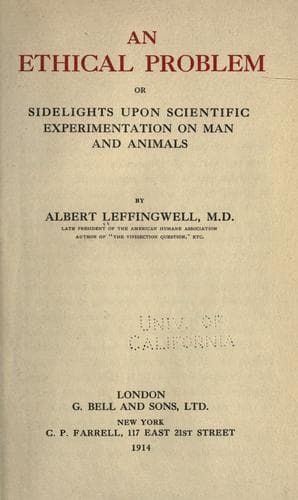
An ethical problem; or, Sidelights upon scientific experimentation on man and animalsLeffingwell, Albert
Philosophy
An ethical problem; or, Sidelights upon scientific experimentation on man and animals
Leffingwell, Albert
Medicine, Experimental; Vivisection
One of the oldest members of the medical profession in Massachusetts
has also written of his experience in Be'rnard's laboratory, and his
account of the cruelty there practised entirely accords with that of
the English physician:
"When I was studying medicine in Paris, it was the custom of a
distinguished physiologist to illustrate his lectures by operations on
dogs. Some of his dissections were not very painful, but others were
attended with excruciating, long-continued agony; and when the piteous
cries of these poor brutes would interrupt his remarks, with a look of
suppressed indignation he would artistically slit their windpipes, and
thus prevent their howling! Curiousity prompted me to inquire of the
janitor whether, after this period of torment, these creatures were
mercifully put out of misery; and I ascertained that such animals as
did not succumb to the immediate effects of their mutilations were
consigned to a cellar, to be kept, unattended and unfed, until wanted
for the following lectures, which occurred on alternate days. I
never noticed the slightest demonstration of sympathy on their behalf,
except on the part of a few American students. These dogs were
subjected to needless torture, for the mere purpose of illustrating
well-known facts, capable of being taught satisfactorily by drawings,
charts, and models; and hence this cruelty, being unattended by any
possible benefit to either students or mankind, was illegitimate and
unjustifiable. But when it is considered that these same experiments
might have been conducted under the influence of an anaesthetic, so
as to minimize, if not remove, this needless suffering, this
cold-blooded, heartless torture can only be characterized as
contemptible and monstrous.
"From detailed accounts communicated to me by eye-witnesses of the
incidents related, I entertain no doubt that barbarous cruelty was
practised at that time in all the Parisian laboratories, though it is
probable that, for novel and horrible experiments, none could rival
the infernal ingenuity in this business of that master-demon, Claude
Be'rnard."[1]
[1] Extracts from letter to Boston Medical and Surgical Journal,
April, 1895.
Such is the memory which Be'rnard has left for posterity. It was by
useless cruelty that he impressed. And no American physiologist,
sounding the praises of free and unrestricted vivisection, has ever
yet ventured to criticize or to condemn either the man or his work.
Let us go back a little. By the year 1871, the agitation had gone so
far as to be deemed worthy of consideration by the leading scientific
body in Great Britain. At the meeting of the British Association in
Liverpool of that year, a committee was appointed to consider the
subject of animal experimentation, and the result of their
deliberations appears in the annual report. Regarding the practice,
they suggest four recommendations or rules:
Public-domain text, read in full here on John Shaqi.
Reviews
Reviews
No reviews yet
Be the first to share your thoughts on this work.
Elsewhere in the archive
Join the Discussion
Join the discussion
Sign in to leave a comment or review.
Sign InorCreate an account