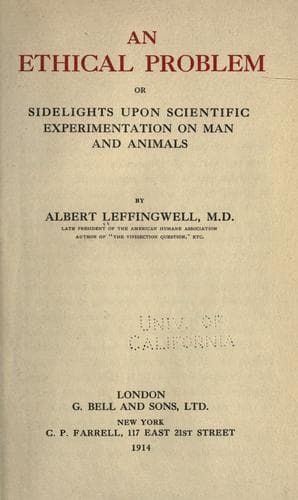
An ethical problem; or, Sidelights upon scientific experimentation on man and animalsLeffingwell, Albert
Philosophy
An ethical problem; or, Sidelights upon scientific experimentation on man and animals
Leffingwell, Albert
Medicine, Experimental; Vivisection
"Indeed, vivisection will always be the better for vigilant
supervision, and for whatever outside pressure can be brought to bear
against it. Such pressure will never be too great, nor will it retard
progress a hair's-breadth in the hands of that very limited class who
are likely materially to advance knowledge by its practice.
"The ground for public supervision is that vivisection, immeasurably
beyond any other pursuit, involves the infliction of torture to little
or no purpose. Motive apart, painful vivisection differs from that
usual cruelty of which the law takes absolute cognizance mainly in
being practised by an educated class, who having once become callous
to its objectionable features, find its pursuit an interesting
occupation under the name of science. In short, though vivisection,
like slavery, may embrace within its practice what is unobjectionable,
what is useful, what is humane, and even what is commendable, it may
also cover what is nothing less than hideous. I use this word in no
sensational sense, and appeal to those who are familiar with some of
the work in laboratories and out of them to endorse it as appropriate
in this connection....
"`But burning was useless, while vivisection is profitable.' Here we
reach the kernel of the argument of the pain-inflicting vivisector.
The reply is that by far the larger part of vivisection is as useless
as was an auto da fe'. It does not lead to discovery. The character
of the minds of most of those who usually practise it makes this
hardly a possibility. Real discoverers are of a different texture of
mind, which you cannot create by schools; nor can you retard their
progress by restrictions, put on all you may. But restrictions will
and should cut off THE HORDE OF DULL TORTURERS WHO FOLLOW IN THE WAKE
OF THE DISCOVERER, actuated by a dozen different motives, from a
desire for research down to the wish to gratify a teacher or to comply
with a school requisition."
How carefully and how clearly the writer has phrased his distinctions
between what in vivisection is right and wrong! In all the literature
of advocacy for free and unrestricted vivisection can we find anything
resembling it? Certainly, I know no writer favourable to unlimited
experimentation who has been equally fair. One surgical
vivisectionist is fond of dividing the class interested in discussion
of vivisection as "Friends of Research," and "Foes of Research,"
ascribing to the first all the virtues of good sense, and to the
latter all the folly that belongs to ignorance. In which class, we
may well wonder, would he place the first American surgeon of his time
because he objected only to cruelty and abuse?
To Dr. Bigelow the legal supervision of the laboratory seemed the one
practical method by which cruelty might be somewhat restrained,
because in this way he believed the public would obtain some knowledge
of the practice which is now withheld. He says:
Public-domain text, read in full here on John Shaqi.
Reviews
Reviews
No reviews yet
Be the first to share your thoughts on this work.
Elsewhere in the archive
Join the Discussion
Join the discussion
Sign in to leave a comment or review.
Sign InorCreate an account