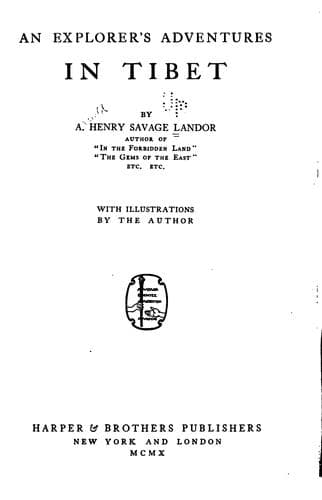
An Explorer's Adventures in TibetLandor, Arnold Henry Savage
History
An Explorer's Adventures in Tibet
Landor, Arnold Henry Savage
Tibet Autonomous Region (China) -- Description and travel
"If you go another step we will cut off your head, or you will have to
cut off ours!" cried two or three others, stretching their bare necks
toward me.
"_Taptih middu_" (I have not got a small knife), I replied, quite
seriously, and with assumed disappointment, twirling my hand in the air
in Tibetan fashion.
The Tibetans did not know what to make of me. When I moved toward the
pass, on which hundreds of flying-prayers flapped in the wind, I
politely bade them good-bye with tongue out, and waving both my hands,
palms upward, in front of my forehead in the most approved Tibetan
style. The soldiers took off their caps and humbly saluted us by going
down on their knees and putting their heads close to the ground.
We crossed the plain, and slowly wended our way up the pass. Near the
top we came to a track, the highway from Ladak to Lhassa _via_ Gartok,
along the northern side of the Rakastal, Mansarowar, and Gunkyo lakes.
On the pass itself were planted several poles connected by ropes, from
which flying-prayers waved gayly in the breeze. _Obos_, or mounds of
stones, had been erected. The slabs used in the construction of these
_obos_ were mostly white, and bore in many instances the inscription
"_Omne mani padme hun_." Yak, goat, and sheep skulls were laid by the
side of the _obos_, the above four words being engraved on the bone, and
stained red with the blood of the animals killed.
Sacrifices are offered by Tibetans when crossing a high pass, especially
if there is a Lama close at hand to commemorate the event. The meat of
the animal killed is eaten by the people present. If the party is a
large one, dancing and singing follow the feast. _Obos_ are found all
over the country, generally on passes or summits of hills. No Tibetan
ever goes by one of these _obos_ without depositing on it a white
stone.
CHAPTER XVI
FIRST WHITE MAN IN THE SACRED PROVINCE
The Maium Pass (17,500 feet), as far as which no white man had ever
penetrated, is a great landmark in Tibet. Not only does one of the
sources of the great Tsangpu, or Brahmaputra River, rise on its
south-east slopes, but it also separates the immense provinces of
Nari-Khorsum (extending west of the Maium Pass and comprising the
mountainous and lake region as far as Ladak) from the Yutzang, the
central province of Tibet, stretching east of the pass along the valley
of the Brahmaputra and having Lhassa for its capital. The word _yu_ in
Tibetan means "middle." It is applied to this province because it
occupies the centre of Tibet. To the north of the Maium lies the Doktol
province.
I had taken a reconnoitring trip to another pass to the north-east of
us, and had just returned to my men on the Maium Pass, when several of
the Tibetan soldiers we had left behind rode up toward us. We waited for
them. Their leader, pointing at the valley beyond the pass, cried: "That
yonder is the Lhassa territory, and we forbid you to enter it!"
Public-domain text, read in full here on John Shaqi.
Reviews
Reviews
No reviews yet
Be the first to share your thoughts on this work.
Elsewhere in the archive
Join the Discussion
Join the discussion
Sign in to leave a comment or review.
Sign InorCreate an account