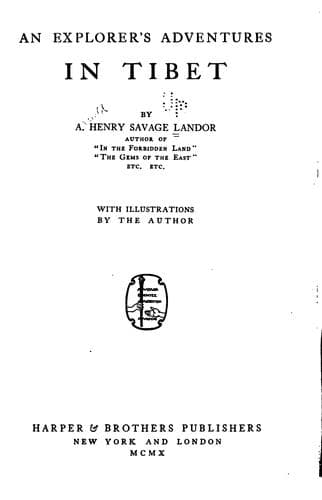
An Explorer's Adventures in TibetLandor, Arnold Henry Savage
History
An Explorer's Adventures in Tibet
Landor, Arnold Henry Savage
Tibet Autonomous Region (China) -- Description and travel
We were asleep under our little tent, the hour being about eleven, when
there was a noise outside as of voices and people stumbling against
stones. I was out in a moment with my rifle, and shouted the usual
"_Palado!_" (Go away!) I could see nothing, owing to the darkness, but
several stones flung from slings whizzed past me. One of these hit the
tent. A dog barked furiously. I fired a shot, which had the good effect
of producing a hasty retreat of our enemies. The dog remained barking
all night. In the morning, when I gave him food and caressed him in
Tibetan fashion, with the usual words of endearment, "_Chochu, chochu_,"
he rubbed himself against my legs as if he had known me all his life,
and eventually lay down by the side of Mansing, to whom he took a
particular fancy. From that day the dog never left our camp, and
followed us everywhere until harder times came upon us.
The river was turning too much toward the south. I decided to abandon it
and strike across country, especially as there were faint signs of a
track leading over a pass to the east-south-east of our camp. I followed
this track. Along it I detected marks of hundreds of ponies' hoofs, now
almost entirely washed away. This was evidently the way taken by the
soldiers we had met on the other side of the Maium Pass.
Having risen over the pass, 17,750 feet high, we saw before us an
extensive valley with barren hills scattered upon it. To the south we
observed a large plain some ten miles wide, with snowy peaks rising on
the farther side. In front was a hill and a _mani_ wall. This latter
discovery made me feel quite confident that I was on the highroad to
Lhassa. About eight miles off to the north-north-west were high snowy
peaks, and as we went farther we discovered a lofty mountain range, with
still higher peaks, three miles behind it. We had travelled half-way
across the waterless plain when we noticed a number of soldiers' heads
and matchlocks popping in and out from behind a distant hill. After a
while they came out in numbers to observe our movements, then retired
again behind the hill. We proceeded. When we were still half a mile from
them they abandoned their hiding-place and galloped away before us,
raising clouds of dust. From a hill 16,200 feet high, over which the
track crossed, we perceived a group of very high snowy peaks about eight
miles distant. Between them and us stood a range of hills cut by a
valley, along which flowed a river carrying a large volume of water.
This we followed, and crossed it at a suitable fording-place where the
stream was twenty-five yards across. The water reached up to our waists.
We found here another _mani_ wall with large inscriptions on stones. As
the wind was high and cutting, we used the wall as a shelter for the
night. We could see in the distance the snowy Himahlyan chain. Lower
hill ranges were not more than three miles from camp. The river we had
just crossed flowed into the Brahmaputra. We were at an elevation of
15,700 feet.
Public-domain text, read in full here on John Shaqi.
Reviews
Reviews
No reviews yet
Be the first to share your thoughts on this work.
Elsewhere in the archive
Join the Discussion
Join the discussion
Sign in to leave a comment or review.
Sign InorCreate an account