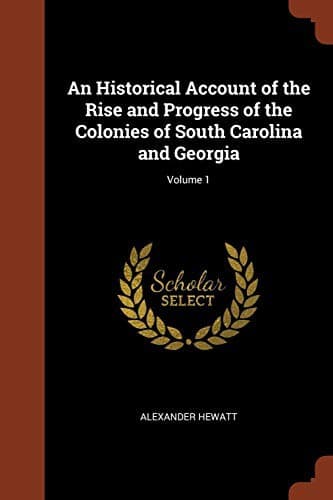
An Historical Account of the Rise and Progress of the Colonies of South Carolina and Georgia, Volume 1Hewatt, Alexander
History
An Historical Account of the Rise and Progress of the Colonies of South Carolina and Georgia, Volume 1
Hewatt, Alexander
Georgia -- History -- Colonial period, ca. 1600-1775; South Carolina -- History -- Colonial period, ca. 1600-1775
submit their necks any more to the proprietary yoke; and therefore for
the future Governor Johnson dropt all thoughts of making any more
attempts for that purpose.
[Sidenote] Injurious suspicions with regard to the conduct of the
Governor.
Nicholas Trott now observing the frame of the proprietary government
totally unhinged, and a rival Judge planted in his room, resolved to
return to England. But before he embarked he wrote to Governor Johnson,
acquainting him with his resolution, and promising, if he would
contribute towards defraying his expences, he would give the Proprietors
each a favourable account of his conduct and services, as would ensure to
him the continuance of his office. But the Governor being no stranger to
the character of the Judge, and being convinced that both the revolt of
the people, and subversion of government, were in a great measure to be
ascribed his pernicious policy and secret correspondence with his friend
the secretary to the Proprietors, disdainfully rejected his interest and
friendship. To which disrespect for the Judge, however, Mr. Johnson
attributed many of the injurious suspicions the Proprietors entertained
of his honour and fidelity, and that shameful neglect with which he was
afterwards treated by them. They had wrote him no answer to his letters
respecting the violent steps the people had taken, or ever informed him
whether his conduct during those popular commotions had met with their
approbation or disapprobation. Some of them even alledged that he was
privy to the designs of the malecontents; and gave them too much
countenance and indulgence. But every principle of honour, duty and
interest forbade such a connivance, and the upright and respectable
character he maintained, rendered such suspicions groundless and
unmerited. That he should join with a disaffected multitude in schemes of
opposition, to divest himself of his government, was a thing scarcely to
be supposed. That he should first wink at the subversion of the
proprietary government, and afterwards refuse to govern them for the
King, when solicited so to do by the representatives and whole body of
the people, was a thing very improbable. When he arrived in the province,
he found the inhabitants discontented and unhappy; but little suspected
then they had any views of renouncing their allegiance to the
Proprietors; and the various arts the people used to conceal from him
their designs, were proofs they had every thing to fear, and nothing to
hope for from their Governor. The many attempts made to defeat their
measures were also evidences of his fidelity to their Lordships, and
firmness in support of their government. He indeed differed with Trott
and Rhett, the two favourites of the Proprietors, and perhaps to this,
among other causes, the neglect with which he was treated by their
Lordships may be ascribed. For as they discovered on all occasions such a
partial regard to these men, and placed such unlimited confidence in
Public-domain text, read in full here on John Shaqi.
Reviews
Reviews
No reviews yet
Be the first to share your thoughts on this work.
Elsewhere in the archive
Join the Discussion
Join the discussion
Sign in to leave a comment or review.
Sign InorCreate an account