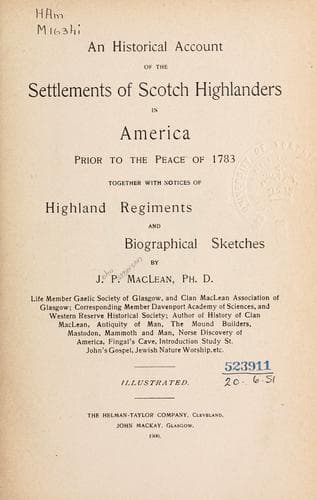
An Historical Account of the Settlements of Scotch Highlanders in AmericaMacLean, J. P. (John Patterson)
History
An Historical Account of the Settlements of Scotch Highlanders in America
MacLean, J. P. (John Patterson)
Scots -- America; Scots -- United States
"Sir: I received your favor by Captain James Walker, and observed
your declared sentiments of revolt, hostility and rebellion to the
King, and to what I understand to be the constitution of the country.
If I am mistaken future consequences must determine; but while I
continue in my present sentiment, I shall consider myself embarked in
a cause which must, in its consequences, extricate this country from
anarchy and licentiousness. I cannot conceive that the Scottish
emigrants, to whom I imagine you allude, can be under greater
obligations to this country than to the King, under whose gracious
and merciful government they alone could have been enabled to visit
this western region: And I trust, Sir, it is in the womb of time to
say, that they are not that deluded and ungrateful people which you
would represent them to be. As a soldier in his Majesty's service, I
must inform you, if you are to learn, that it is my duty to conquer,
if I cannot reclaim, all those who may be hardy enough to take up
arms against the best of masters, as of Kings. I have the honor to
be, in behalf of the army under my command,
Sir, your most obedient servant,
Don. McDonald.
To the Commanding Officer at Rockfish."[50]
MacDonald realized that he was unable to put his threat into execution,
for he was informed that the minute-men were gathering in swarms all
around him; that Colonel Caswell, at the head of the minute men of
Newbern, nearly eight hundred strong, was marching through Duplin
county, to effect a junction with Moore, and that his communication with
the war ships had been cut off. Realizing the extremity of his danger,
he resolved to avoid an engagement, and leave the army at Rockfish in
his rear, and by celerity of movement, and crossing rivers at
unsuspected places, to disengage himself from the larger bodies and fall
upon the command of Caswell. Before marching he exhorted his men to
fidelity, expressed bitter scorn for the "base cravens who had deserted
the night before," and continued by saying:
"If any amongst you is so faint-hearted as not to serve with the
resolution of conquering or dying, this is the time for such to
declare themselves."
The speech was answered by a general huzza for the king; but from
Cotton's corps about twenty laid down their arms. He decamped, with his
army at midnight, crossed the Cape Fear, sunk his boats, and sent a
party fifteen miles in advance to secure the bridge over South river,
from Bladen into Hanover, pushing with rapid pace over swollen streams,
rough hills, and deep morasses, hotly pursued by General Moore.
Perceiving the purpose of the enemy General Moore detached Colonels
Lillington and Ashe to reinforce Colonel Caswell, or if that could not
be effected, then they were to occupy Widow Moore's Creek bridge.
Public-domain text, read in full here on John Shaqi.
Reviews
Reviews
No reviews yet
Be the first to share your thoughts on this work.
Elsewhere in the archive
Join the Discussion
Join the discussion
Sign in to leave a comment or review.
Sign InorCreate an account