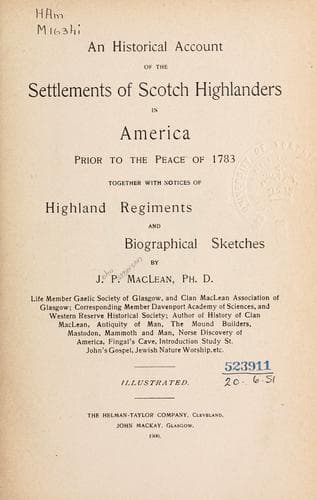
An Historical Account of the Settlements of Scotch Highlanders in AmericaMacLean, J. P. (John Patterson)
History
An Historical Account of the Settlements of Scotch Highlanders in America
MacLean, J. P. (John Patterson)
Scots -- America; Scots -- United States
The royalists, expecting an easy victory, decided upon an immediate
attack. General MacDonald was confined to his tent by sickness, and the
command devolved upon Major Donald MacLeod, who began the march at one
o'clock on the morning of the 27th; but owing to the time lost in
passing an intervening morass, it was within an hour of daylight when
they reached the west bank of the creek. They entered the ground without
resistance. Seeing Colonel Caswell was on the opposite side they reduced
their columns and formed their line of battle in the woods. Their
rallying cry was, "King George and broadswords," and the signal for
attack was three cheers, the drum to beat and the pipes to play. While
it was still dark Major MacLeod, with a party of about forty advanced,
and at the bridge was challenged by the sentinel, asking, "Who goes
there?" He answered, "A friend." "A friend to whom?" "To the king." Upon
this the sentinels bent their faces down to the ground. Major MacLeod
thinking they might be some of his own command who had crossed the
bridge, challenged them in Gaelic; but receiving no reply, fired his own
piece, and ordered his party to fire also. All that remained of the
bridge were the two logs, which had served for sleepers, permitting only
two persons to pass at a time. Donald MacLeod and Captain John Campbell
rushed forward and succeeded in getting over. The Highlanders who
followed were shot down on the logs and fell into the muddy stream
below. Major MacLeod was mortally wounded, but was seen to rise
repeatedly from the ground, waving his sword and encouraging his men to
come on, till twenty-six balls penetrated his body. Captain Campbell
also was shot dead, and at that moment a party of militia, under
Lieutenant Slocum, who had forded the creek and penetrated a swamp on
its western bank, fell suddenly upon the rear of the royalists. The loss
of their leader and the unexpected attack upon their rear threw them
into confusion, when they broke and fled. The battle lasted but ten
minutes. The royalists lost seventy killed and wounded, while the
patriots had but two wounded, one of whom recovered. The victory was
lasting and complete. The Highland power was thoroughly broken. There
fell into the hands of the Americans besides eight hundred and fifty
prisoners, fifteen hundred rifles, all of them excellent pieces, three
hundred and fifty guns and short bags, one hundred and fifty swords and
dirks, two medicine chests, immediately from England, one valued at L300
sterling, thirteen wagons with horses, a box of Johannes and English
guineas, amounting to about $75,000.
Some of the Highlanders escaped from the battlefield by breaking down
their wagons and riding away, three upon a horse. Many who were taken
confessed that they were forced and persuaded contrary to their
inclinations into the service.[51] The soldiers taken were disarmed, and
dismissed to their homes.
Public-domain text, read in full here on John Shaqi.
Reviews
Reviews
No reviews yet
Be the first to share your thoughts on this work.
Elsewhere in the archive
Join the Discussion
Join the discussion
Sign in to leave a comment or review.
Sign InorCreate an account