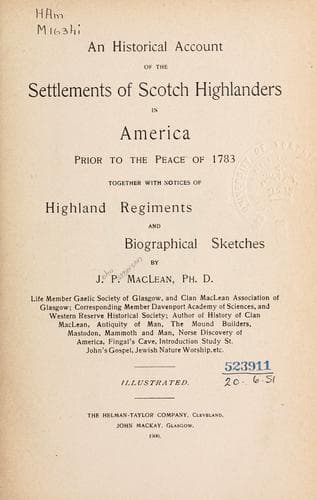
An Historical Account of the Settlements of Scotch Highlanders in AmericaMacLean, J. P. (John Patterson)
History
An Historical Account of the Settlements of Scotch Highlanders in America
MacLean, J. P. (John Patterson)
Scots -- America; Scots -- United States
The same Congress, held in Halifax April 5th, "Resolved, That General
McDonald be admitted to his parole upon the following conditions: That
he does not go without the limits of the Town of Halifax; that he does
not directly or indirectly, while a prisoner, correspond with any person
or persons who are or may be in opposition to American measures, or by
any manner or means convey to them intelligence of any sort; that he
take no draft, nor procure them to be taken by any one else, of any
place or places in which he may be, while upon his parole, that shall
now, or may hereafter give information to our enemies which can be
injurious to us, or the common cause of America; but that without
equivocation, mental evasion, or secret reservation, he pay the most
exact and faithful attention to the intent and meaning of these
conditions, according to the rules and regulations of war; and that he
every day appear between the hours of ten and twelve o'clock to the
Officer of the Guard."[57]
On April 11th, the same parole was offered to Allan MacDonald of
Kingsborough.[58]
The Pennsylvania Committee of Safety, at its session in Philadelphia,
held May 25, 1776, ordered the Highland prisoners, mentioned on page
219, naming each one separately to be "safely kept in close confinement
until discharged by the honorable Congress or this Committee."[59] Four
days later, General MacDonald addressed a letter to the Continental
Congress, in which he said,
"That he was, by a party of horsemen, upon the 28th day of February
last, taken prisoner from sick quarters, eight miles from Widow
Moor's Creek, where he lay dangerously ill, and carried to Colonel
Caswell's camp, where General Moore then commanded, to whom he
delivered his sword as prisoner of war, which General Moore was
pleased to deliver back in a genteel manner before all his officers
then present, according to the rules and customs of war practised in
all nations; assuring him at the same time that he would be well
treated, and his baggage and property delivered to him, &c. Having
taken leave of General Moore and Colonel Caswell, Lieutenant-Colonel
Bryant took him under his care; and after rummaging his baggage for
papers, &c., conducted him to Newbern, from thence with his baggage
to Halifax, where the Committee of Safety there thought proper to
commit him to the common jail; his horses, saddles, and pistols, &c.,
taken from him, and never having committed any act of violence
against the person or property of any man; that he remained in this
jail near a month, until General Howe arrived there, who did him the
honour to call upon him in jail; and he has reason to think that
General Howe thought this treatment erroneous and without a
precedent; that upon this representation to the Convention, General
McDonald was, by order of the Convention, permitted, upon parole, to
the limits of the town of Halifax, until the 25th of April last, when
Public-domain text, read in full here on John Shaqi.
Reviews
Reviews
No reviews yet
Be the first to share your thoughts on this work.
Elsewhere in the archive
Join the Discussion
Join the discussion
Sign in to leave a comment or review.
Sign InorCreate an account