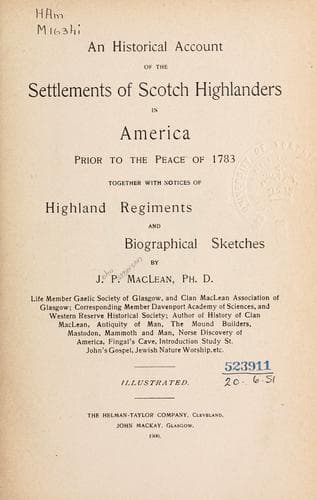
An Historical Account of the Settlements of Scotch Highlanders in AmericaMacLean, J. P. (John Patterson)
History
An Historical Account of the Settlements of Scotch Highlanders in America
MacLean, J. P. (John Patterson)
Scots -- America; Scots -- United States
In the abodes of crime, and of misfortune, the committee beheld all that
the poet depicted: "The freeborn Briton to the dungeon chained," and
"Lives crushed out by secret, barbarous ways, that for their country
would have toiled and bled." One of Britain's authors was moved to
indite: "No modern nation has ever enacted or inflicted greater legal
severities upon insolvent debtors than England."[78]
While the report of the committee did honor to their humanity, yet it
was the moving spirit of Oglethorpe that prompted efforts to combine
present relief with permanent benefits, by which honest but unfortunate
industry could be protected, and the poor enabled to reap the fruit of
their toils, which now wrung out their lives with bitter and unrequited
labor. On June 9, 1732, a charter was procured from the king,
incorporating a body by name and style of the Trustees for Establishing
the Colony of Georgia in America. Among its many provisions was the
declaration that "all and every person born within the said province
shall have and enjoy all liberties, franchises and immunities of free
denizens, as if abiding and born within Great Britain." It further
ordained that there should be liberty of conscience, and free exercise
of religion to all, except Papists. The patrons, by their own request,
were restrained from receiving any grant of lands, or any emoluments
whatever.
The charter had in view the settling of poor but unfortunate people on
lands now waste and desolate, and also the interposing of the colony as
a barrier between the French, Spanish and Indians on the south and west
and the other English colonies on the north. Oglethorpe expressed the
purpose of the colonizing scheme, in the following language:
"These trustees not only give land to the unhappy who go thither;
but are also empowered to receive the voluntary contributions of
charitable persons to enable them to furnish the poor adventurers
with all necessaries for the expense of the voyage, occupying the
land, and supporting them till they find themselves comfortably
settled. So that now the unfortunate will not be obliged to bind
themselves to a long servitude to pay for their passage; for they may
be carried gratis into a land of liberty and plenty, where they
immediately find themselves in possession of a competent estate, in a
happier climate than they knew before; and they are unfortunate,
indeed, if here they cannot forget their sorrow."[79]
Public-domain text, read in full here on John Shaqi.
Reviews
Reviews
No reviews yet
Be the first to share your thoughts on this work.
Elsewhere in the archive
Join the Discussion
Join the discussion
Sign in to leave a comment or review.
Sign InorCreate an account