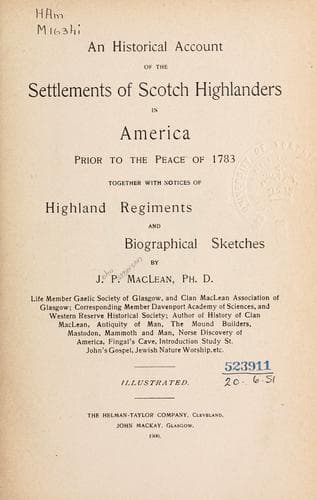
An Historical Account of the Settlements of Scotch Highlanders in AmericaMacLean, J. P. (John Patterson)
History
An Historical Account of the Settlements of Scotch Highlanders in America
MacLean, J. P. (John Patterson)
Scots -- America; Scots -- United States
These people being deeply religious selected for their pastor, Reverend
John MacLeod, a native of Skye, who belonged to the Dunvegan family of
MacLeods. He was well recommended by his clerical brethren, and
sustained a good examination before the presbytery of Edinburgh,
previous to his ordination and commission, October 13, 1735. He was
appointed by the directors of the Society in Scotland for Propagating
Christian Knowledge (from whom he was to receive his annual stipend of
L50) "not only to officiate as minister of the Gospel to the Highland
families going hither," and others who might be inclined to the
Presbyterian form of worship, but "also to use his utmost endeavors for
propagating Christian knowledge among natives in the colony."
The Trustees were greatly rejoiced to find that they had secured so
valuable an acquisition to their colony, and that they could settle such
a bold and hardy race on the banks of their southern boundary, and thus
establish a new town on the Florida frontier. The town council of
Inverness, in order to express their regard for Oglethorpe, on account
of his kind offers to the Highlanders, conferred on him the honor of a
burgess of the town, through his proxy, Captain George Dunbar.
Besides the military band, others, among whom were MacKays, Bailies,
Dunbars, and Cuthberts, applied for large tracts of land to people with
their own servants; most of them going over themselves to Georgia, and
finally settling there for life.
Of the Highlanders, some of them paid their passage and that of one out
of two servants, while others paid passage for their servants and took
the benefit of the trust passage for themselves. Some, having large
families, wanted farther assistance for servants, which was acceded to
by Captain Dunbar, who gave them the passage of four servants, which was
his right, for having raised forty of the one hundred men. Of the whole
number the Trustees paid for one hundred and forty-six, some of whom
became indentured servants to the Trust. On October 20, 1735, one
hundred and sixty-three were mustered before Provost Hassock at
Inverness. One of the number ran away before the ship sailed, and two
others were set on shore because they would neither pay their passage
nor indent as servants to the Trust.
Public-domain text, read in full here on John Shaqi.
Reviews
Reviews
No reviews yet
Be the first to share your thoughts on this work.
Elsewhere in the archive
Join the Discussion
Join the discussion
Sign in to leave a comment or review.
Sign InorCreate an account