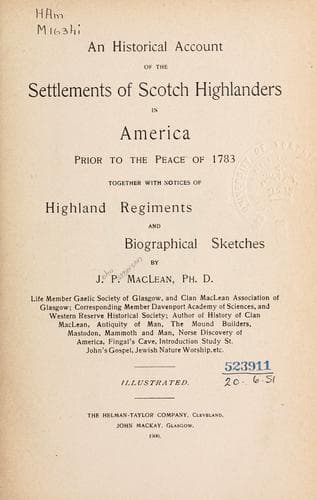
An Historical Account of the Settlements of Scotch Highlanders in AmericaMacLean, J. P. (John Patterson)
History
An Historical Account of the Settlements of Scotch Highlanders in America
MacLean, J. P. (John Patterson)
Scots -- America; Scots -- United States
It was one of the agreements made by the Trust that assistance should be
given the colonists. Hence Oglethorpe speaks of "the L58 delivered to
Mr. McIntosh at Darien, it was to support the Inhabitants of Darien with
cloathing and delivered to the Trustees' Store there, for which the
Individuals are indebted to the Trust. Part of it was paid in discharge
of service done to the Trustees in building. Part is still due and some
do pay and are ready to pay."[89]
The active war with Spain commenced by the murder of two unarmed
Highlanders on Amelia Island, who had gone into the woods for fuel. It
was November 14, 1739, that a party of Spaniards landed on the island
and skulked in the woods. Francis Brooks, who commanded a scout boat,
heard reports of musketry, and at once signaled the fort, when a
lieutenant's squad marched out and found the murdered Highlanders with
their heads cut off and cruelly mangled. The Spaniards fled with so much
precipitation that the squad could not overtake them, though they
pursued rapidly. Immediately Oglethorpe began to collect around him his
inadequate forces for the invasion of Florida. In January, 1740, he
received orders to make hostile movements against Florida, with the
assurance that Admiral Vernon should co-operate with him. Oglethorpe
took immediate action, drove in the Spanish outposts and invaded
Florida, having learned from a deserter that St. Augustine was in want
of provisions. South Carolina rendered assistance; and its regiment
reached Darien the first of May, where it was joined by Oglethorpe's
favorite corps, the Highlanders, ninety strong, commanded by Captain
John Mohr McIntosh and Lieutenant MacKay. They were ordered, accompanied
by an Indian force, to proceed by land, at once, to Cow-ford (afterwards
Jacksonville), upon the St. Johns. With four hundred of his regiment,
Oglethorpe, on May 3d, left Frederica, in boats, and on the 9th reached
the Cow-ford. The Carolina regiment and the Highlanders having failed to
make the expected junction at that point, Oglethorpe, who would brook no
delay, immediately proceeded against Fort Diego, which surrendered on
the 10th, and garrisoned it with sixty men under Lieutenant Dunbar. With
the remainder he returned to the Cow-ford, and there met the Carolina
regiment and McIntosh's Highlanders. Here Oglethorpe massed nine hundred
soldiers and eleven hundred Indians, and marched the whole force
against Fort Moosa, which was built of stone, and situated less than two
miles from St. Augustine, which the Spaniards evacuated without offering
resistance. Having burned the gates, and made three breaches in the
walls, Oglethorpe then proceeded to reconnoitre the town and castle.
Assisted by some ships of war lying at anchor off St. Augustine bar, he
determined to blockade the town. For this purpose he left Colonel
Palmer, with ninety-five Highlanders and fifty-two Indians, at Fort
Moosa, with instructions to scour the woods and intercept all supplies
Public-domain text, read in full here on John Shaqi.
Reviews
Reviews
No reviews yet
Be the first to share your thoughts on this work.
Elsewhere in the archive
Join the Discussion
Join the discussion
Sign in to leave a comment or review.
Sign InorCreate an account