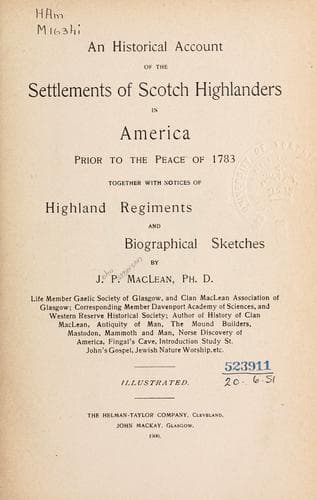
An Historical Account of the Settlements of Scotch Highlanders in AmericaMacLean, J. P. (John Patterson)
History
An Historical Account of the Settlements of Scotch Highlanders in America
MacLean, J. P. (John Patterson)
Scots -- America; Scots -- United States
To what extent the Darien Highlanders espoused the cause of Great
Britain would be difficult to fathom, but in all probability to no
appreciable extent. The records exhibit that there were some royalists
there, although when under British sway may have been such as a matter
of protection, which was not uncommon throughout the Southern States.
The record is exceedingly brief. On May 20, 1780, Charles McDonald,
justice of peace for St. Andrew's parish (embracing Darien), signed the
address to the King. Sir James Wright, royal governor of Georgia,
writing to lord George Germain, dated February 16, 1782, says:
"Yesterday my Lord I Received Intelligence that two Partys of about
140 in the whole were gone over the Ogechee Ferry towards the
Alatamaha River & had been in St. Andrews Parish (a Scotch
settlement) & there Murdered 12 or 13 Loyal Subjects."[93]
The Highlanders were among the first to take action, and had no fears of
the calamities of war. The military spirit of their ancestors showed no
deterioration in their constitutions. During the second week in January,
1775, a district congress was held by the inhabitants of St. Andrew's
Parish (now Darien), at which a series of resolutions were passed,
embodying, with great force and earnestness, the views of the
freeholders of that large and flourishing district. These resolutions,
six in number, expressed first, their approbation of "the unparalleled
moderation, the decent, but firm and manly, conduct of the loyal and
brave people of Boston and Massachusetts Bay, to preserve their
liberty;" their approval of "all the resolutions of the Grand American
Congress," and their hearty and "cheerful accession to the association
entered into by them, as the wisest and most moderate measure that could
be adopted." The second resolution condemned the closing of the land
offices, to the great detriment of Colonial growth, and to the injury of
the industrious poor, declaring "that all encouragement should be given
to the poor of every nation by every generous American." The third,
animadverted upon the ministerial mandates which prevented colonial
assemblies from passing such laws as the general exigencies of the
provinces required, an especial grievance, as they affirmed, "in this
young colony, where our internal police is not yet well settled." The
fourth condemned the practice of making colonial officers dependent for
salaries on Great Britain, "thus making them independent of the people,
who should support them according to their usefulness and behavior." The
fifth resolution declares "our disapprobation and abhorrence of the
unnatural practice of slavery in America," and their purpose to urge
"the manumission of our slaves in this colony, upon the most safe and
equitable footing for the masters and themselves." And, lastly, they
thereby chose delegates to represent the parish in a provincial
congress, and instruct them to urge the appointment of two delegates to
Public-domain text, read in full here on John Shaqi.
Reviews
Reviews
No reviews yet
Be the first to share your thoughts on this work.
Elsewhere in the archive
Join the Discussion
Join the discussion
Sign in to leave a comment or review.
Sign InorCreate an account