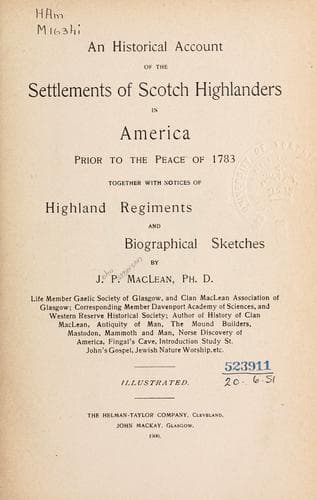
An Historical Account of the Settlements of Scotch Highlanders in AmericaMacLean, J. P. (John Patterson)
History
An Historical Account of the Settlements of Scotch Highlanders in America
MacLean, J. P. (John Patterson)
Scots -- America; Scots -- United States
The quit rent in the province of New York was fixed at two shillings six
pence for every one hundred acres. The fees for a grant of a thousand
acres were as follows: To the governor, $31.25; secretary of state, $10;
clerk of the council, $10 to $15; receiver general, $14.37; attorney
general, $7.50; making a total of about $75, besides the cost of survey.
This amount does not appear to be large for the number of acres, yet it
must be considered that land was plenty, but money very scarce. There
were thousands of substantial men who would have found it exceedingly
difficult to raise the amount in question.
It is possible that Captain Campbell could not have paid this extortion
even if he had been so disposed; but being high-spirited, he resolutely
refused his consent. The governor, still pretending to be very anxious
to aid the emigrants, recommended the legislature of the province to
grant them assistance; but, as usual, the latter was at war with the
governor, and refused to vote money to the Highlanders, which they
suspected, with good reason, the latter would be required to pay to the
colonial officers for fees.
Not yet discouraged, Captain Campbell determined to exhaust every
resource that justice might be done to him. His next step was to appeal
to the legislature for redress, but it was in vain; then he made an
application to the Board of Trade, in England, which had the power to
rectify the wrong. Here he had so many difficulties to contend with that
he was forced to leave the colonists to themselves, who soon after
separated. But all his efforts proved abortive.
The petition of Lieutenant Donald Campbell, though courteously
expressed, and eminently just, was rejected. It was claimed that the
orders of the English government positively forbade the granting of over
a thousand acres to any one person; yet that thousand acres was denied
him.
The injustice accorded to Captain Campbell was more or less notorious
throughout the province. It was generally felt there had been bad
treatment, and there was now a disposition on the part of the colonial
authorities to give some relief to his sons and daughters. Accordingly,
on November 11, 1763, a grant of ten thousand acres, in the present
township of Greenwich, Washington county, New York, was made to the
three brothers, Donald, George and James, their three sisters and four
other persons, three of whom were also named Campbell.
The final success of the Campbell family in obtaining redress inspired
others who had belonged to the colony to petition for a similar
recompense for their hardships and losses. They succeeded in obtaining a
grant of forty-seven thousand, four hundred and fifty acres, located in
the present township of Argyle, and a small part of Fort Edward and
Greenwich, in the same county.
On March 2, 1764, Alexander McNaughton and one hundred and six others of
the original Campbell emigrants and their descendants, petitioned for
one thousand acres to be granted to each of them
Public-domain text, read in full here on John Shaqi.
Reviews
Reviews
No reviews yet
Be the first to share your thoughts on this work.
Elsewhere in the archive
Join the Discussion
Join the discussion
Sign in to leave a comment or review.
Sign InorCreate an account