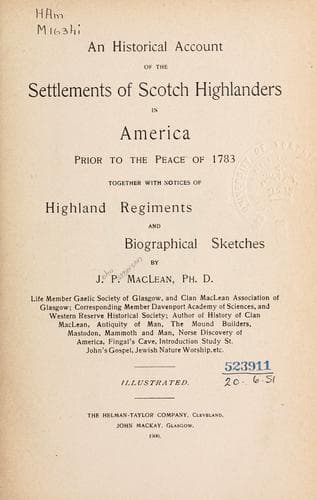
An Historical Account of the Settlements of Scotch Highlanders in AmericaMacLean, J. P. (John Patterson)
History
An Historical Account of the Settlements of Scotch Highlanders in America
MacLean, J. P. (John Patterson)
Scots -- America; Scots -- United States
As might have been, and perhaps was, anticipated, the Highland
settlement became the source of information and the base of supplies for
the enemy. Spies and messengers came and went, finding there a welcome
reception. The trail leading from there and along the Sacandaga and
through the Adirondack woods, soon became a beaten path from its
constant use. The Highland women gave unstintingly of their supplies,
and opened their houses as places of retreat. Here were planned the
swift attacks upon the unwary settlers farther to the south and west.
Agents of the king were active everywhere, and the Highland homes became
one of the resting places for refugees on their way to Canada. This
state of affairs could not be concealed from the Americans, who, none
too soon, came to view the whole neighborhood as a nest of treason.
Military force could not be employed against women and children (for
from time to time nearly all the men had left), but they could be
removed where they would do but little harm. General Schuyler discussed
the matter with General Herkimer and the Tryon County Committee, when it
was decided to remove of those who remained "to the number of four
hundred." A movement of this description could not be kept a secret,
especially when the troops were put in motion. In March, 1777, General
Schuyler had permitted both Alexander and John MacDonald to visit their
families. Taking the alarm, on the approach of the troops, in May, they
ran off to Canada, taking with them the residue of the Highlanders,
together with a few of the German neighbors. The journey was a very long
and tedious one, and very painful for the aged, the women, and the
children. They were used to hardships and bore their sufferings without
complaint. It was an exodus of a people, whose very existence was almost
forgotten, and on the very lands they cleared and cultivated there is
not a single tradition concerning them.
From papers still in existence, preserved in Series B, Vol. 158, p. 351,
of the Haldeman Papers, it would appear that some of the families,
previous to the exodus, had been secured, as noted in the two following
petitions, both written in either 1779 or 1780, date not given although
first is simply dated "27th July," and second endorsed "27th July":
"To His Excellency General Haldimand, General and Commander in Chief
of all His Majesty's Forces in Canada and the Frontiers thereof,
The memorial of John and Alexander Macdonell, Captains in the King's
Royal Regiment of New York, humbly sheweth,
That your Memorialist, John Macdonell's, family are at present
detained by the rebels in the County of Tryon, within the Province of
New York, destitute of every support but such as they may receive
from the few friends to Government in said quarters, in which
situation they have been since 1777.
Public-domain text, read in full here on John Shaqi.
Reviews
Reviews
No reviews yet
Be the first to share your thoughts on this work.
Elsewhere in the archive
Join the Discussion
Join the discussion
Sign in to leave a comment or review.
Sign InorCreate an account