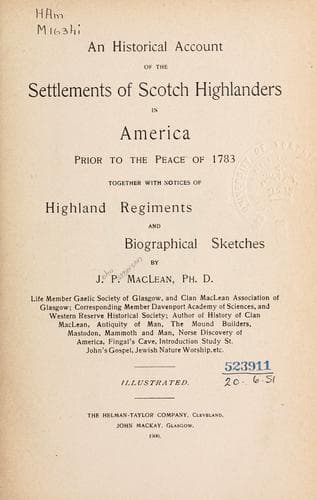
An Historical Account of the Settlements of Scotch Highlanders in AmericaMacLean, J. P. (John Patterson)
History
An Historical Account of the Settlements of Scotch Highlanders in America
MacLean, J. P. (John Patterson)
Scots -- America; Scots -- United States
Under circumstances, such as above narrated, it is not surprising that
the people refused to settle on the company's land. In consequence of
this, when the supplies did arrive, the agents refused to give them any.
To add still further to the difficulties, there arose a jealously
between them and the older settlers; Ross quarrelled with the company,
and ultimately he left the newcomers to their fate. The few who had a
little money with them bought food of the agents, while others, less
fortunate, exchanged clothing for provisions; but the majority had
absolutely nothing to buy with; and what little the others could
purchase was soon devoured. Driven to extremity they insisted on having
the supplies that had been sent to them. They were positively refused,
and now determined on force in order to save the colony from starvation.
Donald McDonald and Colin Douglass went to the store seized the agents,
tied them, took their guns from them, which they hid at a distance. Then
they carefully measured the articles, took account of what each man
received, that the same might be paid for, in case they should ever
become able. They then left, leaving behind them Roderick McKay, a man
of great energy and determination, a leader among them, who was to
liberate the agents--Robert Patterson and Dr. Harris--as soon as the
others could get to a safe distance, when he released them and informed
them where their guns might be found, and then got out of the way
himself.
Intelligence was at once dispatched to Halifax that the Highlanders were
in rebellion, from whence orders were sent to Captain Thomas Archibald
of Truro, to march his company of militia to Pictou to suppress and
pacify the rebels; but to his honor, be it said, he pointedly refused,
and made reply, "I will do no such thing; I know the Highlanders, and if
they are fairly treated there will be no trouble with them." Correct
representations of the case were sent to Halifax, and as lord William
Campbell, whose term as governor had just expired, was still there, and
interesting himself on behalf of the colony as his countrymen, he
secured orders for the provisions. Robert Patterson, in after years,
admitted that the Highlanders, who had arrived in poverty, paid him
every farthing with which he had trusted them, notwithstanding the fact
that they had been so badly treated.
Public-domain text, read in full here on John Shaqi.
Reviews
Reviews
No reviews yet
Be the first to share your thoughts on this work.
Elsewhere in the archive
Join the Discussion
Join the discussion
Sign in to leave a comment or review.
Sign InorCreate an account