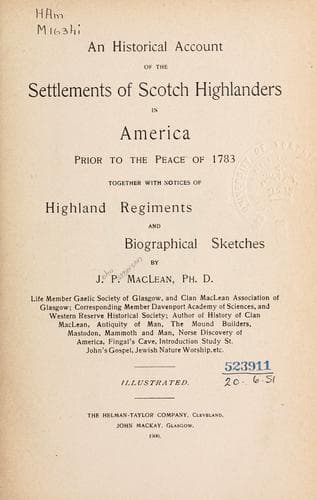
An Historical Account of the Settlements of Scotch Highlanders in AmericaMacLean, J. P. (John Patterson)
History
An Historical Account of the Settlements of Scotch Highlanders in America
MacLean, J. P. (John Patterson)
Scots -- America; Scots -- United States
The troops under Washington were accompanied by a body of Highlanders.
On the morning of November 25th, the army advanced with the provincials
in the front. They entered upon an Indian path. "Upon each side of which
a number of stakes, with the bark peeled off, were stuck into the earth,
and upon each stake was fixed the head and kilt of a Highlander who had
been killed or taken prisoner at Grant's defeat. The provincials, being
front, obtained the first view of these horrible spectacles, which it
may readily be believed, excited no kindly feelings in their breasts.
They passed along, however, without any manifestation of their violent
wrath. But as soon as the Highlanders came in sight of the remains of
their countrymen, a slight buzz was heard in their ranks, which rapidly
swelled and grew louder and louder. Exasperated not only by the
barbarous outrages upon the persons of their unfortunate fellow soldiers
who had fallen only a few days before, but maddened by the insult which
was conveyed by the exhibition of their kilts, and which they well
understood, as they had long been nicknamed the 'petticoat warriors' by
the Indians, their wrath knew no bounds. Directly a rapid and violent
tramping was heard, and immediately the whole corps of the Highlanders,
with their muskets abandoned, and broad swords drawn, rushed by the
provincials, foaming with rage, and resembling, as Captain Craighead
coarsely expressed it, 'mad boars engaged in battle,' swearing vengeance
and extermination upon the French troops who had permitted such
outrages. Their march was now hastened--the whole army moved forward
after the Highlanders, and when they arrived somewhere about where the
canal now passes, the Fort was discovered to be in flames, and the last
of the boats, with the flying Frenchmen, were seen passing down the Ohio
by Smoky Island. Great was the disappointment of the exasperated
Highlanders at the escape of the French, and their wrath subsided into a
sullen and relentless desire for vengeance."[138]
The Highlanders passed the winter of 1758 in Pittsburg, and in May
following marched to the assistance of General Amherst in his
proceedings at Ticonderoga, Crown Point and the Lakes.
Before the heroic action of The Black Watch at Ticonderoga was known in
England, a warrant was issued conferring upon the regiment the title of
Royal, so that it became known also by the name of 42d Royal Highland
Regiment, and letters were issued to raise a second battalion. So
successful were the recruiting officers that within three months, seven
companies, each one hundred and twenty men strong were embodied at Perth
in October 1758. Although Highlanders only were admitted, yet two
officers, anxious to obtain commissions, enlisted eighteen Irishmen,
several of whom were O'Donnels, O'Lachlans, O'Briens, &c. The O was
changed to Mac, and the Milesians passed muster as true Macdonels,
Maclachlans, and Macbriars, without being questioned.
Public-domain text, read in full here on John Shaqi.
Reviews
Reviews
No reviews yet
Be the first to share your thoughts on this work.
Elsewhere in the archive
Join the Discussion
Join the discussion
Sign in to leave a comment or review.
Sign InorCreate an account