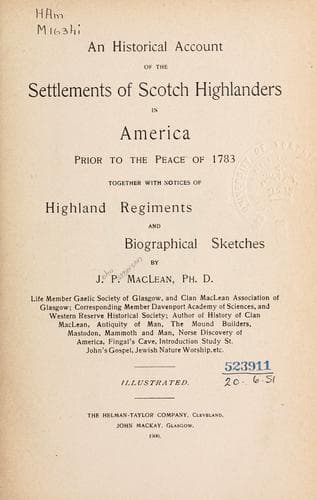
An Historical Account of the Settlements of Scotch Highlanders in AmericaMacLean, J. P. (John Patterson)
History
An Historical Account of the Settlements of Scotch Highlanders in America
MacLean, J. P. (John Patterson)
Scots -- America; Scots -- United States
At the close of the year 1761 The Black Watch, with ten other regiments,
among which was Montgomery's Highlanders, embarked for Barbadoes, there
to join an armament against Martinique and Havanna. After the surrender
of Havanna, the first battalion of the 42nd, and Montgomery's
Highlanders embarked for New York, which they reached in the end of
October, 1762. Before leaving Cuba, all the men of the second battalion
of the 42nd, fit for service were consolidated with the first, and the
remainder shipped to Scotland, where they were reduced the following
year.
The 42nd, or The Black Watch was stationed at Albany till the summer of
1763 when they, with a detachment of Montgomery's Highlanders and
another of the 60th, under command of Colonel Henry Boquet, were sent to
the relief of Fort Pitt, then besieged by the Indians. This expedition
consisting of nine hundred and fifty-six men, with its convoy, reached
Fort Bedford, July 25, 1763. The whole country in that region was
aroused by the depredations of the Indians. On the 28th Boquet moved his
army out of Fort Bedford and marched to Fort Ligonier, where he left his
train, and proceeded with pack-horses. Before them lay a dangerous
defile, several miles in length, commanded the whole distance by high
and craggy hills. On August 5th, when within half a mile of Bushy-Run,
about one o'clock in the afternoon, after a harrassing march of
seventeen miles, they were suddenly attacked by the Indians; but two
companies of the 42nd Highlanders drove them from their ambuscade. When
the pursuit ceased, the savages returned. These savages fought like men
contending for their homes, and their hunting grounds. To them it was a
crisis which they were forced to meet. Again the Highlanders charged
them with fixed bayonets; but as soon as they were driven from one post
they appeared at another, and at last entirely surrounded the English,
and would have entirely cut them off had it not been for the cool
behavior of the troops and the good manoeuvering of the commander.
Night came on, and the English remained on a ridge of land, commodious
for a camp, except for the total want of water. The next morning the
army found itself still in a critical position. If they advanced to give
battle, then their convoy and wounded would fall a prey to the enemy; if
they remained quiet, they would be picked off one by one, and thus
miserably perish. Boquet took advantage of the resolute intrepidity of
the savages by feigning a retreat. The red men hurried to the charge,
when two companies concealed for the purpose fell upon their flank;
others turned and met them in front; and the Indians yielding to the
irresistible shock, were utterly routed.
Public-domain text, read in full here on John Shaqi.
Reviews
Reviews
No reviews yet
Be the first to share your thoughts on this work.
Elsewhere in the archive
Join the Discussion
Join the discussion
Sign in to leave a comment or review.
Sign InorCreate an account