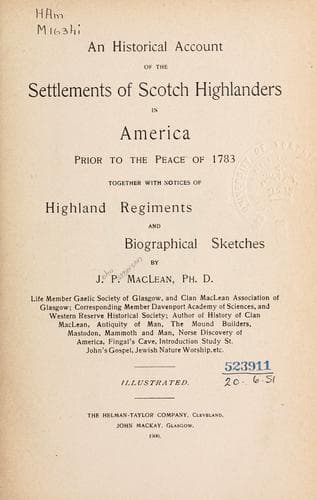
An Historical Account of the Settlements of Scotch Highlanders in AmericaMacLean, J. P. (John Patterson)
History
An Historical Account of the Settlements of Scotch Highlanders in America
MacLean, J. P. (John Patterson)
Scots -- America; Scots -- United States
Of the officers who were in the regiment in 1759 seven rose to be
general officers, viz., Francis Grant of Grant, John Reid of Strathloch,
Allan Campbell of Glenure, James Murray, son of lord George Murray, John
Campbell of Strachur, Thomas Stirling of Ardoch, and John Small. Those
who became field officers were, Gordon Graham, Duncan Campbell of
Inneraw, Thomas Graham of Duchray, John Graham his brother, William
Murray of Lintrose, William Grant, James Abercromby of Glassa, James
Abercromby junior, Robert Grant, James Grant, Alexander Turnbull of
Strathcathro, Alexander Donaldson, Thomas Fletcher of Landertis, Donald
Robertson, Duncan Campbell, Alexander Maclean and James Eddington. A
corp of officers, respectable in their persons, character and rank in
private society, was of itself sufficient to secure esteem and lead a
regiment where every man was a soldier.
It has already been noticed that in the spring of 1760, the thought of
General Amherst was wholly engrossed on the conquest of Canada. He was
appealed to for protection against the Cherokees who were committing
cruelties, in their renewed warfare against the settlements. In April he
detached, from the central army, that had conquered Ohio, Colonel
Montgomery with six hundred Highlanders of his own regiment and six
hundred Royal Americans to strike a blow at the Cherokees and then
return. The force embarked at New York, and by the end of April was in
Carolina. At Ninety-six, near the end of May, the army was joined by
many gentlemen of distinction, as volunteers, besides seven hundred
Carolina rangers, which constituted the principal strength of the
country. On June 1st, the army crossed Twelve-mile River; and leaving
their tents standing on advantageous ground, at eight in the evening
moved onward through the woods to surprise Estatoe, about twenty miles
from the camp. On the way Montgomery surprised Little Keowee and put
every man to the sword, sparing only women and children. Early the next
morning they reached Estatoe only to find it abandoned, except by a few
who could not escape. The place was reduced to ashes, as was Sugar Town,
and every other settlement in the lower nation destroyed. For years, the
half-charred rafters of their houses might be seen on the desolate
hill-sides. "I could not help pitying them a little," wrote Major Grant;
"their villages were agreeably situated; their houses neatly built;
there were everywhere astonishing magazines of corn, which were all
consumed." The surprise in every town was almost equal, for the whole
was the work of only a few hours; the Indians had no time to save what
they valued most; but left for the pillagers money and watches, wampum
and furs. About sixty Cherokees were killed; forty, chiefly women and
children, were made prisoners; but the warriors had generally escaped to
the mountains.
Public-domain text, read in full here on John Shaqi.
Reviews
Reviews
No reviews yet
Be the first to share your thoughts on this work.
Elsewhere in the archive
Join the Discussion
Join the discussion
Sign in to leave a comment or review.
Sign InorCreate an account