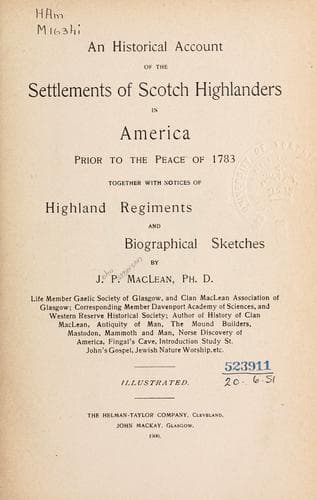
An Historical Account of the Settlements of Scotch Highlanders in AmericaMacLean, J. P. (John Patterson)
History
An Historical Account of the Settlements of Scotch Highlanders in America
MacLean, J. P. (John Patterson)
Scots -- America; Scots -- United States
The acquisition of Canada, by keen sighted observers, was regarded as a
source of danger to England. As early as the year 1748, the Swedish
traveller Kalm, having described in vivid language the commercial
oppression under which the colonists were suffering, added these
remarkable words:
"I have been told, not only by native Americans, but by English
emigrants publicly, that within thirty or fifty years the English
colonies in North America may constitute a separate state entirely
independent of England. But as this whole country towards the sea is
unguarded, and on the frontier is kept uneasy by the French, these
dangerous neighbors are the reason why the love of these colonies for
their metropolis does not utterly decline. The English government
has, therefore, reason to regard the French in North America as the
chief power which urges their colonies to submission."[142]
On the definite surrender of Canada, Choiseul said to those around him,
"We have caught them at last"; his eager hopes anticipating an early
struggle of America for independence. The French ministers consoled
themselves for the Peace of Paris by the reflection that the loss of
Canada was a sure prelude to the independence of the colonies.
Vergennes, the sagacious and experienced ambassador, then at
Constantinople, a grave, laborious man, remarkable for a calm temper and
moderation of character, predicted to an English traveller, with
striking accuracy, the events that would occur. "England," he said,
"will soon repent of having removed the only check that could keep her
colonies in awe. They stand no longer in need of her protection. She
will call on them to contribute towards supporting the burdens they have
helped to bring on her, and they will answer by striking off all
dependence."
It is not to be presumed that Englishmen were wholly blind to this
danger. There were advocates who maintained that it would be wiser to
restore Canada and retain Guadaloupe, with perhaps Martinico and St.
Lucia. This view was supported with distinguished ability in an
anonymous paper, said to have been written by William Burke, the friend
and kinsman of the great orator. The views therein set forth were said
to have been countenanced by lord Hardwicke. The tide of English opinion
was, however, very strongly in the opposite direction.
FOOTNOTES:
[Footnote 136: Stewart's Sketches of the Highlanders, Vol. II, p. 66.]
[Footnote 137: Sketches of the Highlanders, Vol. I, p. 289.]
[Footnote 138: The Olden Time, Vol. I, p. 181.]
[Footnote 139: Spark's Writings of Washington, Vol. II, p. 332.]
[Footnote 140: Stewart's Sketches of the Highlanders, Vol. II, p. 61.]
[Footnote 141: See Appendix, Note L.]
[Footnote 142: Pinkerton's Travels, Vol. XIII.]
CHAPTER XII.
SCOTCH HOSTILITY TO AMERICA.
Public-domain text, read in full here on John Shaqi.
Reviews
Reviews
No reviews yet
Be the first to share your thoughts on this work.
Elsewhere in the archive
Join the Discussion
Join the discussion
Sign in to leave a comment or review.
Sign InorCreate an account