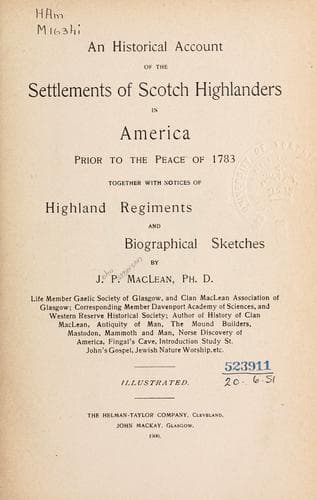
An Historical Account of the Settlements of Scotch Highlanders in AmericaMacLean, J. P. (John Patterson)
History
An Historical Account of the Settlements of Scotch Highlanders in America
MacLean, J. P. (John Patterson)
Scots -- America; Scots -- United States
America, either as Commission or non Commissioned Officers or private
Men, they shall respectively receive further grants of Land from us
within our said province, free of all charges, and exempt from the
payment of quit rents for 20 years, in the same proportion to their
respective Ranks, as is directed and prescribed by our Royal
Proclamation of the 7th of October 1763 in regard to such officers
and soldiers as were employed in our service during the last War."
This paltry scheme concocted to raise men for the royal cause could have
but very little effect. The Highlanders, it proposed to reach, were
scattered, and the work proposed must be done secretly and with
expedition. To raise the Highlanders required address, a number of
agents, and necessary hardships. Armed with the warrant Colonel Maclean
and some followers preceded to New York and from there to Boston, where
the object of the visit became known through a sergeant by name of
McDonald who was trying to enlist "men to join the King's Troops; they
seized him, and on his examination found that he had been employed by
Major Small for this Purpose; they sent him a Prisoner into Connecticut.
This has raised a violent suspicion against the Scots and Highlanders
and will make the execution of Coll Maclean's Plan more difficult."[150]
The principal agents engaged with Colonel Maclean in raising the new
regiment were Major John Small and Captain Alexander McDonald. The
latter met with much discouragement and several escapes. His
"Letter-Book" is a mine of information pertaining to the regiment. As
early as November 15, 1775, he draws a gloomy picture of the straits of
the Macdonalds on whom so much was relied by the English government. "As
for all the McDonalds in America they may Curse the day that was born as
being the means of Leading them to ruin from my Zeal and attachment for
government poor Glanaldall I am afraid is Lost as there is no account of
him since a small Schooner Arrived which brought an account of his
having Six & thirty men then and if he should Not be Lost he is
unavoidably ruined in his Means all those up the Mohawk river will be
tore to pieces and those in North Carolina the same so that if
Government will Not Consider them when Matters are Settled I think they
are ill treated."[151]
The commissions of Colonel Maclean, Major John Small and Captain
William Dunbar bear date of June 13, 1775, and all the other captains
one day later.
Public-domain text, read in full here on John Shaqi.
Reviews
Reviews
No reviews yet
Be the first to share your thoughts on this work.
Elsewhere in the archive
Join the Discussion
Join the discussion
Sign in to leave a comment or review.
Sign InorCreate an account