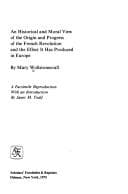
An historical and moral view of the origin and progress of the French Revolution; and the effect it has produced in EuropeWollstonecraft, Mary
Philosophy
An historical and moral view of the origin and progress of the French Revolution; and the effect it has produced in Europe
Wollstonecraft, Mary
France -- History -- Revolution, 1789-1799 -- Causes
Arrived at Paris, they were received with enthusiasm, as the saviours of
their country; and saw there more than a hundred thousand men in arms,
formed into companies; showing the superiority of a nation rising in
it’s own defence, compared with the mercenary machines of tyranny. The
transports of the people, and the sympathy of the deputies, must have
formed a highly interesting scene: success elevating the heart for the
moment, and hope gilding the future prospect.—But the imagination would
languidly pourtray this dazzling sunshine, depressed by the recollection
of the sinister events, that have since clouded the bright beams.
Precluded then by melancholy reflections from rejoicing with the happy
throng, it is necessary to turn our attention to the circumstances, from
which mankind may draw instruction:—and the first that present
themselves to our notice are those which disconcerted the flagitious
plan of the ministry;—the regulations that preserved order in the
metropolis;—the astonishing reduction of the Bastille;—the union of the
french guards with the citizens;—the prompt establishment of a city
militia;—and, in short, the behaviour of the people, who showed neither
a thirst for pillage, nor a fondness for tumult.
The court by their criminal enterprises had entirely disorded the
political machines, that sustained the old worn out government[19];
which, worm-eaten in all it’s pillars, and rotten in all it’s joints,
fell at the first shock—never to rise again. The destruction of the
Bastille—that fortress of tyranny! which for two centuries had been the
shame and terrour of the metropolis[20], was the sentence of death of
the old constitution.
The junction of the three orders in fact securing the power of the
national assembly, and making the court appear a cipher, could not fail
to prove sorely mortifying to it’s old minions; and the success of the
people on the 14th of july proclaiming their supremacy, the courtiers,
resorting to their old arts, suggested to the king a line of conduct the
most plausible and flattering to the inconsiderate partizans of a
revolution; whilst it betrayed to the more discerning a dissimulation as
palpable as the motives of the advisers were flagrantly interested. For
their views being narrowed by the depravity of their character, they
imagined, that his apparent acquiescence, exciting the admiration and
affection of the nation, would be the surest mode of procuring him that
consequence in the government, which ultimately might tend to overthrow
what they termed an upstart legislature; and, by the appropriation of
chances, reinstate the tyranny of unlimited monarchy.
Public-domain text, read in full here on John Shaqi.
Reviews
Reviews
No reviews yet
Be the first to share your thoughts on this work.
Elsewhere in the archive
Join the Discussion
Join the discussion
Sign in to leave a comment or review.
Sign InorCreate an account