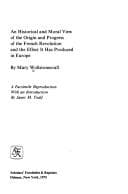
An historical and moral view of the origin and progress of the French Revolution; and the effect it has produced in EuropeWollstonecraft, Mary
Philosophy
An historical and moral view of the origin and progress of the French Revolution; and the effect it has produced in Europe
Wollstonecraft, Mary
France -- History -- Revolution, 1789-1799 -- Causes
CHAPTER I.
A DEPUTATION OF THE NATIONAL ASSEMBLY ARRIVES AT PARIS. BAILLIE CHOSEN
MAYOR, AND LA FAYETTE COMMANDER IN CHIEF OF THE NATIONAL GUARDS.
RESIGNATION OF THE MINISTRY. NECKER RECALLED. THE KING VISITS PARIS.
CHARACTER OF THE PARISIANS. THE REVOLUTION URGED ON PREMATURELY.
EMIGRATIONS OF SEVERAL OF THE NOBILITY AND OTHERS. CALONNE ADVISES THE
FRENCH PRINCES TO STIR UP FOREIGN POWERS AGAINST FRANCE. FOULON KILLED.
The presence of the deputies had diffused throughout the capital the
most intoxicating joy—for where is joy expressed with such infantile
playfulness, such entire forgetfulness of to-morrow, as at Paris? and
the citizens, with their usual burst of gratitude, which always
resembles adoration, made choice of Baillie, the first acting president
of the national assembly, for mayor, and of La Fayette for commander in
chief of the national guards: the name now given to the
_garde-bourgeoise_, and the other soldiers incorporated with them. But
the rapture of the parisians, as transient as lively, dwindled, as their
spirits were exhausted, into the murmurs of suspicion.—The ministry,
said they, who were chosen to depress us, are not yet dismissed; and the
troops, that were to have been their instruments of mischief, still
hover round Paris, and are even augmented by the arrival of two fresh
regiments at St. Denis. A rumour was spread, that a convoy of flour had
been intercepted by the order of the ministers, in it’s way to Paris;
and some disturbances at the Bastille had given colour to a report, that
they had attempted to make themselves once more masters of this
important fortress. The night of the 15th was then another devoted to
watchfulness and anxiety; and in the morning a deputation was sent to
the national assembly, praying them to demand the dismission of the
present ministry, and the recall of Necker.
The assembly took the subject into deliberation; but still attentive to
_etiquette_, they debated about the decorum of interfering with the
appointment of the executive power. This roused the genius of Mirabeau;
and the bubbles of fear, and the straw-like objections of timidity, were
carried away by the torrent of his eloquence. The discussion grew warm;
yet for the present occasion soon became of little importance, because
the ministry, finding that they could not stand the brunt of the storm,
resigned; Necker also, in whom the public had still the most implicit
confidence, was invited to return;—and the king, appearing to be anxious
to give every proof of his desire to establish general tranquillity,
signified, that he wished to visit Paris. A short time after they were
officially informed that the troops were promptly removing to more
distant quarters. The national assembly accordingly sent some of their
members to communicate to the parisians this welcome intelligence, to
prepare for the reception of the king by calming the fears of the
people.
Public-domain text, read in full here on John Shaqi.
Reviews
Reviews
No reviews yet
Be the first to share your thoughts on this work.
Elsewhere in the archive
Join the Discussion
Join the discussion
Sign in to leave a comment or review.
Sign InorCreate an account