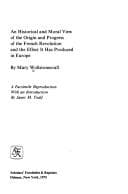
An historical and moral view of the origin and progress of the French Revolution; and the effect it has produced in EuropeWollstonecraft, Mary
Philosophy
An historical and moral view of the origin and progress of the French Revolution; and the effect it has produced in Europe
Wollstonecraft, Mary
France -- History -- Revolution, 1789-1799 -- Causes
The house of Austria was at this period engaged in a war with the turks,
which obliged it to withdraw most of it’s troops from Flanders; and the
intelligence, that the flemings, highly discontented with the
innovations, which the vain weathercock Joseph the Second had made in
their form of worship, were on the eve of an insurrection, more against
the folly of the man than the despotism of his court, calmed the fears
of the french, as to the danger of being immediately attacked by
Germany. This security, for they had no dread of Sardinia, made them
consider the possibility of a counter-revolution being effected by
foreign enemies as far from alarming. It is true, there was not any just
cause of apprehension, unless they took into the calculation, that the
policy of Europe for ages past had been subject to sudden changes; a
state of profound tranquillity giving place to sanguinary scenes of
confusion, and inhuman butcheries—often about such trifling insults and
idle pretentions, as individuals would be ashamed to make a pretext for
quarrelling; and having reason to expect these changes as long as the
systems of courts preserve their existence, France could not reckon,
with any degree of certainty, on the continuation of peace.—Neither did
the national assembly appear to have calculated upon it; for they
undoubtedly betrayed symptoms of pusillanimity, when they suffered their
conduct to be in the smallest degree influenced by the apprehension of a
combination of the crowned heads of Europe to replace the royal diadem
of France, should the most brilliant of it’s jewels be touched by
profane hands.
These fears, perhaps, were the secret cause, combined with the old habit
of adoring the king, as a point of honour, and loving the court, as an
affair of taste, that induced them to preserve the shadow of monarchy in
the new order of things. It’s preservation might have been politically
necessary; because, before abolishing any ancient form, it is necessary
to secure whatever political good may have flowed from it, and guard
against being exhausted by cutting off an excrescence.—But, if the
continuance of a king in the new system were expedient to avert present
evil, they should have allowed him the power necessary to give energy to
the government; and making him responsible for the rectitude of his
actions, the man would have had a fair trial, and posterity, judging of
his conduct, would have been enabled to form a just estimate of a kingly
government.
Public-domain text, read in full here on John Shaqi.
Reviews
Reviews
No reviews yet
Be the first to share your thoughts on this work.
Elsewhere in the archive
Join the Discussion
Join the discussion
Sign in to leave a comment or review.
Sign InorCreate an account