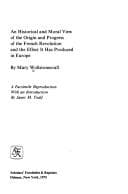
An historical and moral view of the origin and progress of the French Revolution; and the effect it has produced in EuropeWollstonecraft, Mary
Philosophy
An historical and moral view of the origin and progress of the French Revolution; and the effect it has produced in Europe
Wollstonecraft, Mary
France -- History -- Revolution, 1789-1799 -- Causes
A design formed very early, and systematically pursued, was probably
rendered entirely abortive by the obstinacy of the court; who still
persisted to cherish the belief, that the public opinion was changed
only for the moment, and that their deeply rooted love of royalty would
bring them back to what they termed their duty, when the effervescence
excited by novelty had subsided. And thinking, that the cordial
reception given by the parisians to the soldiery had contributed to
estrange them, and effect the revolution, they determined to regain
their lost ground, and dazzle them by feasts, instead of stealing on
their affections by hospitality.—Still, bearing impatiently their
humiliating situation, the courtiers could not help vauntingly exposing
their project; and the babbling of joy showed the weakness of the heads,
that could so soon be intoxicated by hope.
A preparatory step was thought necessary to awaken a sense of allegiance
in the breasts of the people, and to promote a division amongst them, if
not their entire concurrence, after the cabinet should have securely in
their possession the person of the king; and this division would then
enable them to calculate their strength, and act accordingly. For this
purpose, in spite of the comments that had been made on the festivity at
Versailles, which seemed before to insult the misery of the people, and
greatly tended to provoke the exertions that overturned the Bastille and
changed the whole face of things, they projected another entertainment
to seduce the military, encouraged to throng round the court, whilst
famine was at the very gates of Paris. But previously the old french
guards, who had been incorporated with the _garde-bourgeoise_, began to
manifest some symptoms of discontent at not being allowed to guard the
person of the king. Whether they considered their honour as wounded, or
were spirited up to aspire at regaining this privilege, is not decided;
but it is clear, that the court, either to facilitate the entrance of
fresh troops, or from a real dislike to men, who had taken such an
active part in disconcerting their first plot, opposed their wish; and
even the municipality, as has been already noticed, was induced to
request, that a regiment of fresh troops might be called in to guard the
person of the king, and keep the peace, which this trifling dispute,
swelled into an insurrection in the report, threatened to disturb.
Public-domain text, read in full here on John Shaqi.
Reviews
Reviews
No reviews yet
Be the first to share your thoughts on this work.
Elsewhere in the archive
Join the Discussion
Join the discussion
Sign in to leave a comment or review.
Sign InorCreate an account