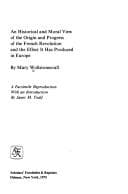
An historical and moral view of the origin and progress of the French Revolution; and the effect it has produced in EuropeWollstonecraft, Mary
Philosophy
An historical and moral view of the origin and progress of the French Revolution; and the effect it has produced in Europe
Wollstonecraft, Mary
France -- History -- Revolution, 1789-1799 -- Causes
Why starts the tear of anguish to mingle with recollections that
sentiment fosters—even in obedience to reason?—For it is wise to be
happy!—and nature and virtue will always open inlets of joy to the
heart. But how quickly vanishes this prospect of delights! of delights
such as man ought to taste!—The cavalcade of death moves along, shedding
mildew over all the beauties of the scene, and blasting every joy! The
elegance of the palaces and buildings is revolting, when they are viewed
as prisons, and the sprightliness of the people disgusting, when they
are hastening to view the operations of the guillotine, or carelessly
passing over the earth stained with blood. Exasperated humanity then,
with bitterness of soul, devotes the city to destruction; whilst turning
from such a nest of crimes, it seeks for consolation only in the
conviction, that, as the world is growing wiser, it must become happier;
and that, as the cultivation of the soil meliorates a climate, the
improvement of the understanding will prevent those baneful excesses of
passion which poison the heart.
A deputation of the national assembly accompanied the royal family to
Paris, as well as the parisian militia. A number of the women preceded
them, mounted on the carriages which they had taken in their way to
Versailles, and on the cannons, covered with national cockades, and
dragging in the dirt those that were considered as symbols of
aristocracy. Soon after they set out, either by chance, or, which is
more probable, pursuant to a plan contrived by some person in power,
forty or fifty loads of wheat and flour fell into the procession, just
before the king, giving weight to the exclamation of the populace, that
they had brought the baker and his family to town.
The assembly continued to sit at Versailles till the nineteenth; and
several interesting debates were entered upon, particularly one brought
forward by the bishop of Autun, respecting the appropriation of the
estates of the clergy to supply the exigences of the government. The
abolition of _lettres de cachet_ was considered, and a fresh
organization of the municipalities proposed; but as none of these
motions were carried before they were more fully discussed at Paris, it
seems best to bring the different arguments on those important subjects
under one point of view.
Settling the articles of the constitution, however, which previously
occupied them, several frivolous discussions, respecting the style of
expression to be adopted to signify the king’s acceptance of their
decrees, were lengthened out with warmth, and puerile objections made to
ancient forms—that were merely forms. After some disputation, the title
of the monarch was changed from king of France, with the rest of the
formule, for that of king of the French; because Rousseau had remarked,
perhaps fastidiously, that the title ought to express rather the chief
of the people, than the master of the soil.
Public-domain text, read in full here on John Shaqi.
Reviews
Reviews
No reviews yet
Be the first to share your thoughts on this work.
Elsewhere in the archive
Join the Discussion
Join the discussion
Sign in to leave a comment or review.
Sign InorCreate an account