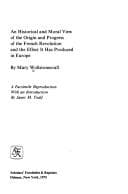
An historical and moral view of the origin and progress of the French Revolution; and the effect it has produced in EuropeWollstonecraft, Mary
Philosophy
An historical and moral view of the origin and progress of the French Revolution; and the effect it has produced in Europe
Wollstonecraft, Mary
France -- History -- Revolution, 1789-1799 -- Causes
sap of the plants they exhaust.’ Nevertheless, in treating with the
nobles, the angles of pride, which time alone could have smoothed
silently away, were, perhaps, too rudely knocked off, for the folly of
distinctions was rapidly wearing itself out, and would probably have
melted gradually before the rational opinions, that were continually
gaining ground, fructifying the soil as they dissolved; instead of which
it was drifted by a hurricane, to spread destruction around as it fell.
Many of the officers, who had served in America during the late war, had
beheld the inhabitants of a whole empire living in a state of perfect
equality; and returned, charmed with their simplicity and integrity, the
concomitants of a just government, erected on the solid foundation of
equal liberty, to scan the rectitude, or policy of a different system.
Convinced of their inutility as nobles, these, when fired with the love
of freedom, seconded the views of the commons with heart and voice. But
the sycophants of the court, and the greater part of the nobility, who
were grossly ignorant of every thing that was not comprised in the art
of living in a continual round of pleasure, insensible of the precipice
on which they were standing, would not, at first, recede a single step
to save themselves; and this obstinacy was the chief cause that led to
the entire new organization of the constitution, framed by the national
assembly. The french in reality were arrived, through the vices of their
government, at that degree of false refinement, which makes every man,
in his own eyes, the centre of the world; and when this gross
selfishness, this complete depravity, prevails in a nation, an absolute
change must take place; because the members of it have lost the cement
of humanity, which kept them together. All other vices are, properly
speaking, superfluous strength, powers running to waste; but this morbid
spot shows, that there is death in the heart. Whatever, indeed, may be
the wisdom or folly of a mixed government of king, lords, and commons,
is of no consequence in the present history; because it appears
sufficiently obvious, that the aristocracy of France destroyed itself,
through the ignorant arrogance of it’s members; who, bewildered in a
thick fog of prejudices, could discern neither the true dignity of man,
nor the spirit of the times.
It also deserves to be noted, that the regeneration of the french
government, at this crisis, depended on the fortitude of the national
assembly at the outset of the contest for, if the court party had
prevailed, the commons would have rested in their usual state of
insignificancy, and their whole proceedings proved only a solemn farce.
They would have wrapped themselves up in their black mantles, like the
herd of undertaker’s men at a funeral, merely to follow with servile
steps the idle cavalcade to it’s resting place; and the people would
only have seen their ancient tyranny revive, tricked out in new
habiliments.
Public-domain text, read in full here on John Shaqi.
Reviews
Reviews
No reviews yet
Be the first to share your thoughts on this work.
Join the Discussion
Join the discussion
Sign in to leave a comment or review.
Sign InorCreate an account