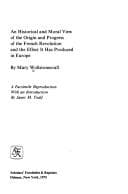
An historical and moral view of the origin and progress of the French Revolution; and the effect it has produced in EuropeWollstonecraft, Mary
Philosophy
An historical and moral view of the origin and progress of the French Revolution; and the effect it has produced in Europe
Wollstonecraft, Mary
France -- History -- Revolution, 1789-1799 -- Causes
Lost then in the most luxurious pleasures, or managing court intrigues,
the queen became a profound dissembler; and her heart hardened by
sensual enjoyments to such a degree, that when her family and favourites
stood on the brink of ruin, her little portion of mind was employed only
to preserve herself from danger. As a proof of the justness of this
assertion, it is only necessary to observe, that, in the general wreck,
not a scrap of her writing has been found to criminate her; neither has
she suffered a word to escape her to exasperate the people, even when
burning with rage, and contempt. The effect that adversity may have on
her choked understanding time will show[11]; but during her prosperity,
the moments of languor, that glide into the interstices of enjoyment,
were passed in the most childish manner; without the appearance of any
vigour of mind, to palliate the wanderings of the imagination.—Still she
was a woman of uncommon address; and though her conversation was
insipid, her compliments were so artfully adapted to flatter the person
she wished to please or dupe, and so eloquent is the beauty of a queen,
in the eyes even of superiour men, that she seldom failed to carry her
point when she endeavoured to gain an ascendancy over the mind of an
individual. Over that of the king she acquired unbounded sway, when,
managing the disgust she had for his person, she made him pay a kingly
price for her favours. A court is the best school in the world for
actors; it was very natural then for her to become a complete actress,
and an adept in all the arts of coquetry that debauch the mind, whilst
they render the person alluring.
Had the hapless Louis possessed any decision of character, to support
his glimmering sense of right, he would from this period have chosen a
line of conduct, that might have saved his life by regulating his future
politics. For this returning affection of the people alone was
sufficient to prove to him, that it was not easy to eradicate their love
for royalty; because, whilst they were contending for their rights with
the nobility, they were happy to receive them as acts of beneficence
from the king. But the education of the heir apparent of a crown must
necessarily destroy the common sagacity and feelings of a man; and the
education of this monarch, like that of Louis XV, only tended to make
him a sensual bigot.
Priests have, in general, contrived to become the preceptors of kings;
the more surely to support the church, by leaning it against the throne.
Besides; kings, who without having their understandings enlarged, are
set above attending to the forms of morality, which sometimes produce
it’s spirit, are always particularly fond of those religious systems,
which, like a sponge, wipe out the crimes that haunt the terrified
imagination of unsound minds.
Public-domain text, read in full here on John Shaqi.
Reviews
Reviews
No reviews yet
Be the first to share your thoughts on this work.
Elsewhere in the archive
Join the Discussion
Join the discussion
Sign in to leave a comment or review.
Sign InorCreate an account