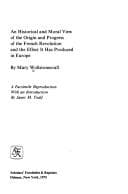
An historical and moral view of the origin and progress of the French Revolution; and the effect it has produced in EuropeWollstonecraft, Mary
Philosophy
An historical and moral view of the origin and progress of the French Revolution; and the effect it has produced in Europe
Wollstonecraft, Mary
France -- History -- Revolution, 1789-1799 -- Causes
The popular leaders had also taken the surest means to ingratiate
themselves with the soldiery, by mixing with them, and continually
insinuating, that citizens ought not to allow the base ministers of
power, to treat them like passive instruments of mischief. Besides, it
was natural to expect, that the military, the most idle body of men in
the kingdom, should attend to the topics of the day, and profit by the
discussions, that disseminated new political principles. And such an
influence had the arguments in favour of liberty on their minds, that,
so early as the 23d of june, during a slight riot, two companies of the
grenadiers refused to fire on the people, whom they were sent to
disperse. But these symptoms of refractoriness roused the resentment of
the court, instead of putting it on it’s guard: consequently several
were sent to prison, and the troops were confined to their barracks;
yet, regardless of these orders, they came in crowds to the _Palais
Royal_, a day or two after, eager to unite their voices with the general
shout, _vive la nation_, which spoke the present sentiments of the
people. The regiments of french, also, that now arrived, to be stationed
with the foreign troops round Paris, were conducted to this hot-bed of
patriotism; and, meeting with the most cordial reception, they listened
with interest to the lively representations of the enormities committed
by their old government, and of the meanness of those men, who could
live on the bread earned by butchering their fellow citizens.
Whilst these opinions were taking root, the people heard, that eleven of
the french guards, confined in the abbey, because they would not obey
the order to fire on the populace, were to be transferred to the
_Bicetre_, the most ignominious of all the prisons. The contest now
commenced; for the people hastened to deliver them, and, forcing their
way, emancipated their friends; and even the hussars, who were called
out to quell the disturbance, laid down their arms. Yet, attentive to
justice, they sent back to confinement a soldier, who had been
previously committed by the police, for some other misdemeanour.
Exasperated as they were, the people, not yet become lawless, guarded
the men they had rescued; whilst they sent a deputation to the national
assembly, to intercede with the king in their behalf. This spirited, yet
prudent, behaviour produced the desired effect; and the assembly named a
certain number of the deputies, who with scrupulous decorum were to
demand this grace of the king: and he accordingly granted their pardon,
laying a cautious stress on it’s being the first request made by the
assembly. But it was still questionable, whether this extorted act of
lenity were not done, like the other actions of the court, only to blind
the preparations that were making, to humble effectually the soldiery,
the metropolis, and the assembly.
Public-domain text, read in full here on John Shaqi.
Reviews
Reviews
No reviews yet
Be the first to share your thoughts on this work.
Elsewhere in the archive
Join the Discussion
Join the discussion
Sign in to leave a comment or review.
Sign InorCreate an account