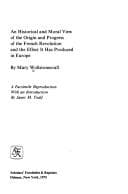
An historical and moral view of the origin and progress of the French Revolution; and the effect it has produced in EuropeWollstonecraft, Mary
Philosophy
An historical and moral view of the origin and progress of the French Revolution; and the effect it has produced in Europe
Wollstonecraft, Mary
France -- History -- Revolution, 1789-1799 -- Causes
During this day, while the parisians were so active for it’s safety, the
national assembly was employed in forming a committee, to be charged
with digesting the plan of a constitution, for the deliberation of the
whole body: to secure the rights of the people on the eternal principles
of reason and justice; and thereby to guarantee the national dignity and
respectability. Towards the evening, the uncertainty of what was passing
at Paris, the mysterious conduct of the cabinet, the presence of the
troops at Versailles, the substantiated facts, and the suspected
proscriptions, gave to this sitting the involuntary emotions, that must
naturally be produced by the approach of a catastrophe, which was to
decide the salvation or destruction of a state. Mirabeau, firm to his
point, showed the necessity of insisting on the sending away the troops
without delay; and soon after the viscount de Noailles, arriving from
Paris, informed them, that the arms had been taken from the _hôtel des
invalides_; and that the Bastille was actually besieged. The first
impulse was for them to go altogether, and endeavour to open the king’s
eyes; but, after some reflection, a numerous deputation was
nominated;—to insist on the removal of the troops; and to speak to his
majesty with that energetic frankness, so much more necessary as he was
deceived by every person by whom he was surrounded. Whilst they were
absent, two persons, sent by the electors of Paris, informed the
assembly of the taking of the Bastille, and the other events of the day;
which were repeated to them, when they returned with the king’s vague
answer.
A second deputation was then immediately sent, to inform him of these
circumstances:—To which he replied—‘You more and more distress my heart,
by the recitals you bring me of the miseries of Paris. But I cannot
believe, that the orders which I have given to the troops, is the cause
of them: I have, therefore, nothing to add to the answer that you have
already received from me.’
This reply tended to increase the general alarm; and they determined
again to prolong the sitting all night; either to be ready to receive
the enemy in their sacred function, or to make a last effort near the
throne to succour the metropolis. Nothing could surpass the anxious
suspense of this situation; for the most resolute of the deputies were
uneasy respecting their fate, because their personal safety was
connected with the salvation of France. Their nocturnal conversation
naturally turned on the late events that had taken place at Paris; the
commotions in the provinces; and the horrours of famine, ready to
consume those whom a civil war spared. The old men sought for an hour of
repose upon the tables and carpets; the sick rested on the benches.—All
saw the sword suspended over them, and over their country—and all feared
a morrow still more dreadful.
Public-domain text, read in full here on John Shaqi.
Reviews
Reviews
No reviews yet
Be the first to share your thoughts on this work.
Elsewhere in the archive
Join the Discussion
Join the discussion
Sign in to leave a comment or review.
Sign InorCreate an account