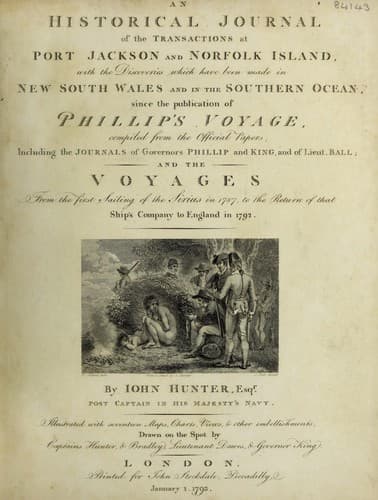
An Historical Journal of the Transactions at Port Jackson and Norfolk IslandHunter, John
History
An Historical Journal of the Transactions at Port Jackson and Norfolk Island
Hunter, John
New South Wales -- History -- Sources
In the month of April we found that Mount Pitt, which is the
highest ground on the island, was, during the night, crowded with
birds. This hill is as full of holes as any rabbit warren; in
these holes at this season these birds burrow and make their
nests, and as they are an aquatic bird, they are, during the
day-time, frequently at sea in search of food; as soon as it is
dark, they hover in vast flocks over the ground where their nests
are. Our people, (I mean seamen, marines, and convicts) who are
sent out in parties to provide birds for the general benefit,
arrive upon the ground soon after dusk, where they light small
fires, which attract the attention of the birds, and they drop
down out of the air as fast as the people can take them up and
kill them: when they are upon the ground, the length of their
wings prevents their being able to rise, and until they can
ascend an eminence, they are unable to recover the use of their
wings; for this purpose, nature has provided them with a strong,
sharp, and hooked bill, and in their heel a sharp spur, with the
assistance of which, and the strength of their bill, they have
been seen to climb the stalk of a tree sufficiently high to throw
themselves upon the wing. This bird, when deprived of its
feathers, is about the size of a pigeon, but when cloathed, is
considerably larger, for their feathers are exceedingly thick;
they are webb-footed, and of a rusty black colour; they make
their holes upon the hills for breeding their young in; they lay
but one egg, and that is full as large as a duck's egg.
They were, at the end of May, as plentiful as if none had been
caught, although for two months before there had not been less
taken than from two to three thousand birds every night; most of
the females taken in May were with egg, which really fills the
whole cavity of the body, and is so heavy that I think it must
fatigue the bird much in flying. This _bird of Providence_,
which I may with great propriety call it, appeared to me to
resemble that sea bird in England, called the puffin: they had a
strong fishy taste, but our keen appetites relished them very
well; the eggs were excellent*.
[* For a further description, and an engraving of
this bird, see the Norfolk-Island Petrel, in Phillip's Voyage,
4to Edition.]
We were highly indebted to Providence for this vast resource;
but as these singular advantages could only be for a season, we
reflected, with pain, that they must have an end, and that in all
probability this would be the case before we got a relief. Fish
was generally mentioned by Governor Phillip, when speaking of
this island, as an inexhaustible resource; he also mentioned the
vast quantity of birds (tropic birds and gannets) which were to
be caught here upon the two small islands (Mount Pitt was not
then known to be the resource we have found it).
Public-domain text, read in full here on John Shaqi.
Reviews
Reviews
No reviews yet
Be the first to share your thoughts on this work.
Elsewhere in the archive
Join the Discussion
Join the discussion
Sign in to leave a comment or review.
Sign InorCreate an account