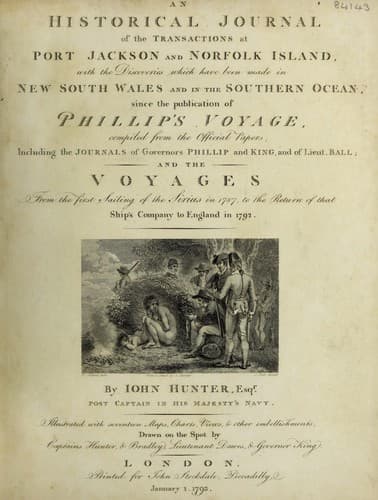
An Historical Journal of the Transactions at Port Jackson and Norfolk IslandHunter, John
History
An Historical Journal of the Transactions at Port Jackson and Norfolk Island
Hunter, John
New South Wales -- History -- Sources
The whole time we had been in this strait, the wind had been
variable from south-south-west to west-north-west; in the night
it sometimes inclined in very light airs from south-south-east to
south. On the 11th, in the afternoon, as we were standing to the
westward, the water appeared suddenly of a very light colour, and
on looking over the side, we perceived the ground under the ship:
before we had time to heave a cast of the lead, it appeared to be
deeper, and we had ten and twelve fathoms; but I am inclined to
think, from what I saw of the bottom, that there could not have
been more than five or six: the bottom was white sand, with some
dark patches upon it. From the mast-head, at the same time, was
seen a dry sand-bank, bearing north-north-east six miles distant;
a little way to the eastward of it, the water seemed to break.
This shoal is very dangerous, and does not appear in any chart
which I have seen: there is a shoal marked in the Dutch charts,
nearly in the same parallel, but it is so very much misplaced in
its longitude, or distance from the land, that I cannot suppose
it has been meant for the same shoal. The latitude of this shoal
is 3 deg. 37' south, and the longitude 117 deg. 54' east; it
extends from the two small islands which are called the Brothers,
and lie off the east part of Borneo, east half north, distant
fifty-one miles.
We made the Brothers at day-light in the morning, after
passing this shoal, and at ten o'clock we passed within three
miles of them, in from twenty-two to seventeen fathoms water,
over a sandy bottom. The latitude of the Brothers is 3 deg. 41'
south, and the longitude 117 deg. 00' east. We stood on to the
south-west, after passing the Brothers, expecting that course
would have carried us clear of every part of Borneo, but the
south part of Borneo, and the large island called Poolo La'oot,
form a considerable bight; into this bight we found a strong
in-draught, by which, and the wind being light, we were drawn,
and could not fetch round Borneo; we stood off and on there with
light and baffling winds, and a short chop of a sea, and gained
no ground: after passing two days and a night in this situation,
we got a breeze, which enabled us to weather the Brothers again,
and stand to the eastward, where we had more room. This situation
gave me some uneasy moments; for we dropt in so fast upon the
shore, that we found it necessary to prepare for anchoring; this
would have occasioned a loss of time, which, from a variety of
circumstances, we could not afford: the anchorage off here is
clear soft ground, and shoals regularly to the shore; we had
twelve fathoms four miles off. This bight ought to be carefully
avoided, for certainly during the prevalence of the easterly
monsoon here, there is a very strong set into it: it would be
much better for ships bound to the westward to get as far to the
southward as the south point of Borneo, before they stretched to
Public-domain text, read in full here on John Shaqi.
Reviews
Reviews
No reviews yet
Be the first to share your thoughts on this work.
Elsewhere in the archive
Join the Discussion
Join the discussion
Sign in to leave a comment or review.
Sign InorCreate an account