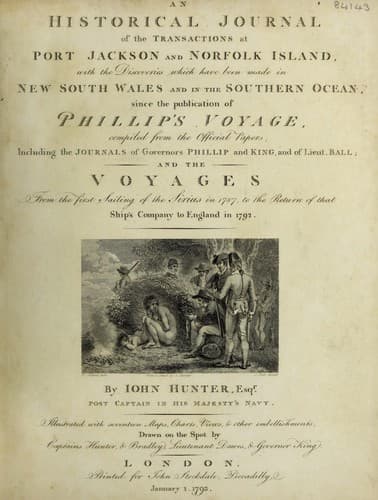
An Historical Journal of the Transactions at Port Jackson and Norfolk IslandHunter, John
History
An Historical Journal of the Transactions at Port Jackson and Norfolk Island
Hunter, John
New South Wales -- History -- Sources
As it blew very fresh all night, I landed the next morning
abreast of the Supply, with the midshipman and surgeon: we walked
across the island to the bay which I had seen the day before.
After ascending a very steep hill, we got to the top of the
island, which we found to be a plain, but every foot of ground
was covered with trees, or the large roots of trees which rose
above the surface of the earth; these were not the only
impediments to our march, as it was impossible for us to walk
four yards, without encountering an almost impenetrable net-work,
composed of a large kind of supple-jack, or vine; which was so
very strong, as to suppress the growth of several trees, by
bending them in every direction; and they so completely stopped
our progress, that we were obliged to cut our way through them.
No grass, or herb of any kind, grew between the roots of these
trees, although the soil every where was extremely rich and good;
but this may be attributed to the total exclusion of the sun, and
the want of air, which doubtless prevent this sort of
vegetation.
The pines, which are numerous, are of an incredible growth:
one of them, which had been blown down, or had fallen by age,
measured 140 feet in length, and several which were measured
standing, were 30 feet in circumference: they grow quite
straight, and have no branches for near 80 feet from the
ground.
We found it impracticable to get into Anson's bay, although we
saw down into it; but the hill over it was a perpendicular cliff,
with a large kind of iris growing on the sides of it, which was a
providential circumstance, for, in our endeavour to get into the
bay, we were all in the greatest danger of falling down the
cliff; indeed, if the iris had not been sufficiently strong to
have supported our weight, we must have fallen down a depth of 90
feet. We were too much pleased with, and thankful for our escape,
to attempt a second trial, as the whole of this side of the
island had the same steep appearance.
In our return, we frequently heard a very distinct cry of
"yaho," which seemed as if it was uttered by an animal or
bird.
During this excursion, we did not see a leaf of flax, or any
herb whatever; the ground, although a rich and deep soil, being
quite bare, which is rather extraordinary, as Captain Cook says
that the flax plant is rather more luxuriant here than at New
Zealand. We saw pigeons, parrots, parroquets, doves, and a
variety of other birds, in great numbers, and so very tame, that
they might be knocked down with a stick.
Large pieces of pumice stone were seen in every part; probably
a crater, or the remains of one, may be found at, or near a
mountain, which rises to a considerable height in the middle of
the island, and which I called Mount Pitt, in honour of the
chancellor of the exchequer.
Public-domain text, read in full here on John Shaqi.
Reviews
Reviews
No reviews yet
Be the first to share your thoughts on this work.
Elsewhere in the archive
Join the Discussion
Join the discussion
Sign in to leave a comment or review.
Sign InorCreate an account