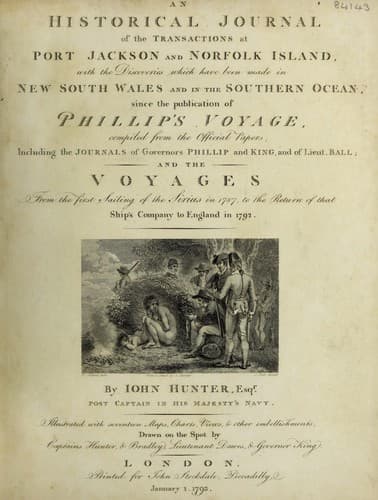
An Historical Journal of the Transactions at Port Jackson and Norfolk IslandHunter, John
History
An Historical Journal of the Transactions at Port Jackson and Norfolk Island
Hunter, John
New South Wales -- History -- Sources
The surgeon, in walking about the island, found out the
flax-plant, which proved to be what we had hitherto called the
iris: not having any description of this plant, I had no idea of
its being what Captain Cook calls the flax-plant of New Zealand;
the cliffs and shore near the settlement were covered with it;
its root is bulbous, and eight leaves issue from it, which are,
in general, five or six feet in length, and about four inches
broad, close to the root: the plant bears a great resemblance to
the iris, except that the leaves are much thicker and larger; the
flaxy part is the fibres, which extend the whole length of the
leaf; towards the root they are very thick and strong, and
diminish in size as they approach the end of the Jeaf. This
plant, in its green state, is of a surprising strength: from the
quantity of dead leaves about the root, I imagine it is an
annual, and that the root sends forth fresh leaves.
The method of preparing the New Zealand flax not being
described by Captain Cook, I caused three bundles of ours to be
put in the rivulet to soak, intending to try it after the
European method of dressing flax. The sawpit being finished on
the 18th, a small pine was cut down near it, which measured 115
feet in length, and two feet six inches diameter at the base: a
twelve foot length was got on the pit, and the sawyers began
sawing it into framings and scantlings for the store-house. By
the 19th, the greatest part of the seeds we had procured at the
Cape of Good Hope, and sown in the garden, were out of the
ground, and seemed likely to do well; but scarcely any of the
English seeds grew, they, in general, being spoiled.
From this time till the 1st of April, two men were employed in
sawing up wood for the store-house; one man was building it, six
were clearing away the ground, and the women burnt up the small
boughs.
The store-house was finished on the 2d: its dimensions were
twelve feet square, and nine feet high. All the provisions and
stores were immediately brought from my tent and deposited in the
store-house.
During the last three days the wind blew very strong from the
south-west, which blighted every plant that was come up and doing
very well; I had also the mortification to find that the rats
were very numerous; they destroyed some Indian corn which was
three inches out of the ground.
As there was every reason to suppose that the south-west winds
would be frequent during the winter, I began to clear the ground
on the north-east side of the hill, (which I named Mount George)
which, of course, would be sheltered from the south and
south-west winds; and it was my intention to continue clearing
the ground in that situation until the middle of June, when I
purposed sowing it with wheat and barley. I now found that no
vegetables would thrive at this season of the year on the south
side of the mount; I therefore ordered the garden ground to be
turned up and sown with wheat.
Public-domain text, read in full here on John Shaqi.
Reviews
Reviews
No reviews yet
Be the first to share your thoughts on this work.
Elsewhere in the archive
Join the Discussion
Join the discussion
Sign in to leave a comment or review.
Sign InorCreate an account