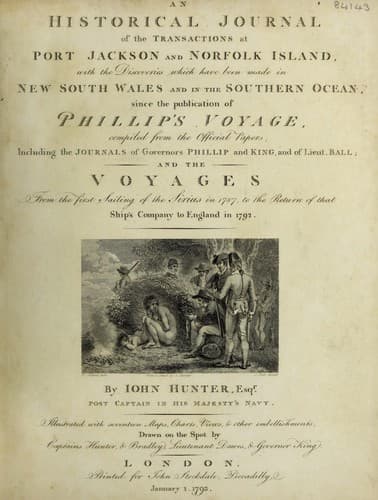
An Historical Journal of the Transactions at Port Jackson and Norfolk IslandHunter, John
History
An Historical Journal of the Transactions at Port Jackson and Norfolk Island
Hunter, John
New South Wales -- History -- Sources
I now set the two sawyers and two carpenters to work in
building houses; one man was employed in making a crab to heave
the boat by, another attended the live-stock, and the remainder
were busied in clearing ground at Mount George, and Arthur's
Vale.
By the 17th, the rain was almost incessant, and, as I had
every reason to suppose it would continue so three or four months
longer, which would endanger the health of those who lived in
tents; I caused the provisions to be removed from the store-house
to a cellar under my house, which was dry, and the stores I put
into a loft; and, as five men and three women lived at present in
tents, I put them into the store-house, until they could build
huts for themselves. The whole settlement were now well
sheltered, except the surgeon and the midshipman; for whom I
proposed to begin a house immediately.
On the 18th, the shell of my house was finished: its
dimensions were twenty-four feet long by twelve feet wide, and
eight feet under the eaves: the sides and roof were
weather-boarded.
I sent the boat out this afternoon, and she returned with
fifty very fine fish, which were issued out as usual.
I set out on the 19th, with an intention of tracing the
rivulet which runs through Arthur's Vale, to its source, and
likewise to examine the extent of the valley; but, after
wandering about the greatest part of the day, I returned back,
much fatigued, and all the cloaths torn off my back by the briars
and the entangled state of the woods.
Arthur's Vale is situated between the north side of Mount
George and the opposite hills: its direction is about
north-north-west into the interior part of the island. The bottom
of this valley, in some places, is not more than thirty yards
wide; in others, at least three hundred. The hills on each side
are cloathed with a thick forest; their ascent is not too steep
for cultivation, and the soil is excellent, being a fat brown
earth.
A very fine rivulet runs through this vale, sufficiently large
to turn any number of mills. As the bank of the sea-shore is
considerably above the level of the rivulet, it sinks into the
earth; and, after passing under the bank, it forces a passage for
itself through a fissure of the rock, on Stony Beach and Turtle
Bay, between high and low water marks, where it boils up with
great force, and is excellent water. As the whole of this water
is not carried off by the passage just mentioned, sufficient to
keep the low ground clear, what does not pass under the bank,
overflows the lower part of the valley, for the space of half a
mile: this swamp might be drained by cutting a channel for the
rivulet to empty itself on the sea-shore; but the operation would
require time and a number of hands, and, when finished, it is not
clear but that the force of the sea would soon fill the channel
up again.
Public-domain text, read in full here on John Shaqi.
Reviews
Reviews
No reviews yet
Be the first to share your thoughts on this work.
Elsewhere in the archive
Join the Discussion
Join the discussion
Sign in to leave a comment or review.
Sign InorCreate an account