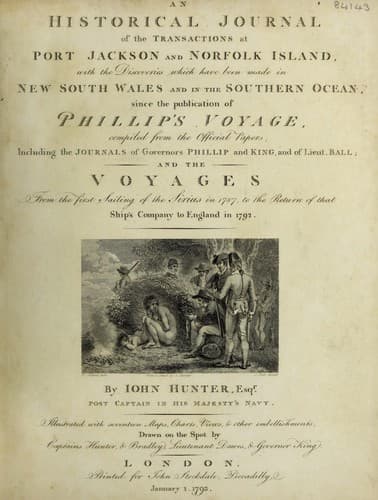
An Historical Journal of the Transactions at Port Jackson and Norfolk IslandHunter, John
History
An Historical Journal of the Transactions at Port Jackson and Norfolk Island
Hunter, John
New South Wales -- History -- Sources
Ans. With twenty more men, and women in proportion exclusive,
I should be able to make a little progress in clearing and
cultivating the ground.
Q. 3. In what time do you think the island will be able to
maintain the additional number of people you wish to have sent
you?
Ans. I think in two years, but in three at most, as answered
by the first question.
Q. 4. What ground have you in cultivation?
Ans. Two acres and an half in barley, and one acre in garden
ground: in September I shall have an acre in Indian corn and
rice.
Q. 5. Have you discovered the flax-plant?
Ans. Yes: some bundles of the flax-plant which I put into
water on the 17th of March were taken up the 27th of July, when
we found that the thick vegetable of the fibres had rotted away,
but still they were covered with an hard woody substance, from
which we have ineffectually tried to separate the flaxy part,
which I have no doubt would make good cordage, canvas, and linen,
as it appears to be of a fine and strong texture. Some lines were
made of it, which were tolerably strong and good; but the want of
a method to separate the woody part from the flax, will be a
great hindrance to its being made useful.
Q. 6. How many acres of clear ground have you found in the
island?
Ans. Not a yard square.
Q. 7. Have you any place round the island at which a vessel of
thirty or forty tons can remain at anchor in security all the
year round?
Ans. None; without removing to the lee side of the island as
the wind changes. Anchorage is good all round the island, as the
bottom is a coral sand: at about two miles from the land the
circular depth is twenty-two fathoms. An harbour might be made by
cutting a channel through the reef about four hundred feet long,
but it would be necessary to blow up some sunken rocks to
facilitate the entry: if it should ever be thought proper to do
this, five vessels of seven feet draught might lie all the year
round in security within the reef: they will not be able to enter
but in the finest weather, with the wind from north-east to
north-west, and then they must warp in: perhaps less difficulty
will be found when I am informed of the state of the weather
during the Summer months.
Q. 8. How far will it be possible to load any ship hereafter
with spars for ships of the line; I mean with respect to the
great difficulty, I am told, there is to land any thing on the
island, or to take any thing off?
Ans. I cannot answer this question so fully as I could wish,
until I am acquainted with the state of the weather during the
summer months. In fine weather, with the wind at north-east,
spars of any dimensions may be sent off from Sydney-Bay, by
mooring a boat without the reef, and hauling the spars off. I
have great reason to suppose anchorage will be very safe off
Sydney-Bay in the summer. I think vessels might be built and
launched in Ball-Bay; and when the flax-plant can be brought to
work, cordage and sails can be made of the finest and strongest
sort.
Public-domain text, read in full here on John Shaqi.
Reviews
Reviews
No reviews yet
Be the first to share your thoughts on this work.
Elsewhere in the archive
Join the Discussion
Join the discussion
Sign in to leave a comment or review.
Sign InorCreate an account