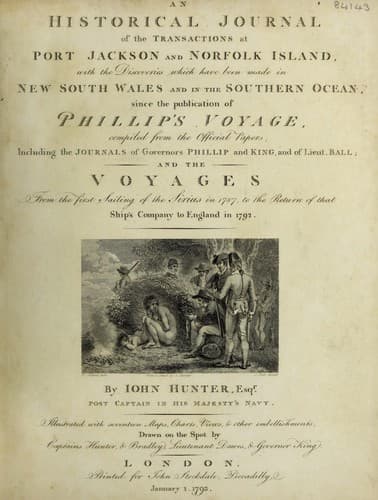
An Historical Journal of the Transactions at Port Jackson and Norfolk IslandHunter, John
History
An Historical Journal of the Transactions at Port Jackson and Norfolk Island
Hunter, John
New South Wales -- History -- Sources
On the 29th, I landed on Nepean Island, and found it to
consist entirely of one mass of sand, held together by the
surrounding cliffs, which are a border of hard rocks:
notwithstanding there was not the least appearance of earth or
mould on the island, yet there were upwards of two hundred very
fine pines growing on it; the surface was covered with a kind of
coarse grass.
The weather being now very hot, I changed the working hours,
and gave the labourers from half past ten o'clock until half past
twelve, to avoid the heat of the sun: they were employed in
clearing ground for cultivation, making shingles, cutting a road
from the settlement to Ball Bay, and reaping wheat and
barley.
The heat of the sun split the weather boarding with which my
house was covered; and it being very leaky, I fet the carpenters
and sawyers to work to put a new roof on, and to raise the house
five feet, in order to make room for stores and provisions.
At day-light in the morning of the 2d of December, I went in
the coble to Phillip Isle, where I landed on a rock, in a small
bay on the north side. It was with difficulty that I ascended the
first hills, which were covered with a sharp long grass that cut
like a knife; this was interspersed with brushwood. The soil is a
light red earth, and was so full of holes, which had been made by
the birds, that walking was very laborious. A small valley runs
the whole length of the island, in which, and on some of the
hills, a few pines grow, but I think the whole island does not
produce more than one hundred and fifty. I found no fresh water
on the island, but probably there may be some, as I saw a number
of hawks, pigeons, and parrots; but as I had only two convicts to
row the boat, I left the island, and got to Sydney Bay in the
evening.
On the 8th, I housed all the barley which had been raised on
an acre of ground, and was sown in June and July. During the
first of its growth, it had a most promising appearance, but when
the ear was shot and nearly filled, some heavy rains in September
laid a great part of it down, and the quantity destroyed by the
rats and quails was almost incredible: there was every prospect
of getting at least fifty bushels of grain, but the whole
quantity, when gleaned, yielded only ten bushels. The barley was
very fine, and 116 ears were produced from one grain. Garden
vegetables throve very well, and cabbages were cut weighing
twenty-six pounds each. I have no doubt but potatoes would thrive
very well here; unfortunately, we had only two sets on the
island, which were brought by the Golden Grove. Most of the
marines and convicts had now very good gardens, but the grub-worm
was a great and perpetual enemy to their vegetables.
It has already been observed, that 260 plants of wheat were
transplanted the beginning of June; these were threshed on the
15th, and the produce was three quarts of a very fine full
grain.
Public-domain text, read in full here on John Shaqi.
Reviews
Reviews
No reviews yet
Be the first to share your thoughts on this work.
Elsewhere in the archive
Join the Discussion
Join the discussion
Sign in to leave a comment or review.
Sign InorCreate an account