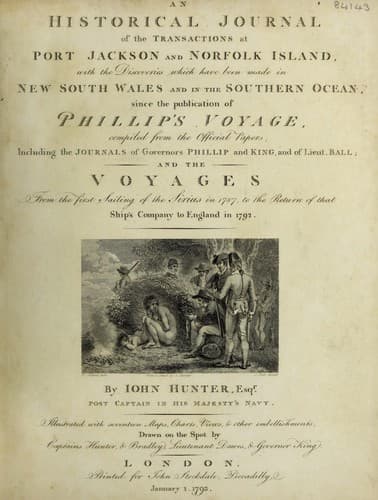
An Historical Journal of the Transactions at Port Jackson and Norfolk IslandHunter, John
History
An Historical Journal of the Transactions at Port Jackson and Norfolk Island
Hunter, John
New South Wales -- History -- Sources
Some barley which had been sown the latter end of May, about
three quarters of an acre with one bushel and an half of seed,
was cut this day, and the produce was twenty-three bushels of a
very fine full grain. The potatoes which were sown during the
month of September, in Arthur's vale, were all running to stalk,
and not one potatoe formed at the roots: the fibres were very
strong and shooting out of the ground, notwithstanding they had
been well earthed: this was probably owing to the very great heat
and drought which we had recently experienced. Large flocks of
parroquets still infested the wheat, and made great havock in one
acre; but as it ripened very fast, I did not apprehend much
farther damage from them or the caterpillars, which were again
become very numerous.
As it would be necessary to have the hogs and poultry near the
granary, during the time of harvest, I employed a party of
labourers in bringing logs to make an inclosure round the barn,
and other conveniencies for the stock; and on the 30th, we began
the wheat harvest.
On the 3d of December, at day-light, the Supply arrived in the
road, and soon afterwards, I received my letters from Governor
Phillip. In the course of the day, six men and eight women
convicts were landed, with some provisions and stores for the
settlement. By an order from Governor Phillip, all persons on the
island were to be put to two-thirds allowance of provisions,
which commenced on the 5th: the settlement at Port Jackson went
to this allowance in November. Having received every thing from
the Supply, that vessel sailed for Port Jackson on the 7th.
All the labourers were now employed in reaping, stacking, and
thatching the wheat, which business was all finished by the 24th.
Four acres of the wheat were greatly damaged by some very heavy
rain, which fell from the 14th to the 18th, and caused it to
shoot out; but this was put into a stack by itself for present
consumption. The wheat now reaped had been sown at different
periods, notwithstanding which, it was ripe nearly at the same
time; but the last sown did not stock so well as that which was
put more early in the ground: that which was sown in drills,
suffered much from the blighting winds; and, as this island is
subject to these winds at all times of the year, the method of
drilling wheat or barley in rows, will not answer so well as when
sown at a broad cast. The best time for sowing wheat, is from the
latter end of May to the middle of June; indeed, that which was
sown in August, yielded a very large sound grain; but, (as I have
already observed) it did not stock so well as the other.
Public-domain text, read in full here on John Shaqi.
Reviews
Reviews
No reviews yet
Be the first to share your thoughts on this work.
Elsewhere in the archive
Join the Discussion
Join the discussion
Sign in to leave a comment or review.
Sign InorCreate an account