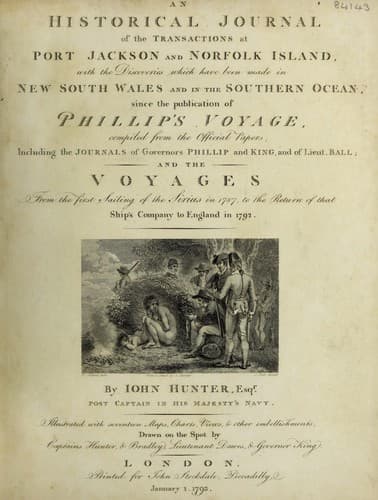
An Historical Journal of the Transactions at Port Jackson and Norfolk IslandHunter, John
History
An Historical Journal of the Transactions at Port Jackson and Norfolk Island
Hunter, John
New South Wales -- History -- Sources
Ury-diow, _To sit nearer any one_.
Wering, _Female_.
Womerraa, _To run_.
Womerra-berra, _To jump_.
Were, _Bad_.
Wadby, _To swim_.
Warre-wee, _To stand_.
Wanne-bow, _To throw away_.
Waltegal, _A large fish_.
Woolamie, _A fish called a light-horseman_.
Ware, _Where_.
Wogan-minnering, _Cutting off_.
Womar, _A throwing-stick_.
Wea-ja-minga, Wea-jow-inia. Wianga, _Relating to the giving of
any thing_.
Wal-lu-merun-wea, _Will you have any more?-
Walloo-bu-diown, _To turn when walking_.
Woroo-woroo! _Go away, or an exclamation of defiance_.
Willin, _The lips_.
Wallo, _The chin_.
Woo-da, _A club_.
Wee-de, _To drink or suck_.
Wan-aree, _The eyebrow_.
Wee-lang, _Lips_.
War-ra, _The breast of a man_.
Wa-gan, _A crow_.
Wir-gan, _A bird called fryar_.
Wad-dy, _A stick or tree_.
Wong-ara, _A male child_.
Wy-anga, _A mother_.
Wo-la-ba, _A young kanguroo_.
Waregal, _A large dog_.
Wy-a-jenuriga, _Give me_.
Wur-ra, _A rat_.
Wil-bing, _To fly, or the wing of a bird_.
Wa-ra-bee, _A cockel_.
Worgye, _To whistle_.
Wya-bo-in-ya, _Take this_.
We-ring, _The female of animals_.
Wa, _Where_.
Wong-ara jug-ga-me, _A child carried on the shoulder_.
Yenu, Yenmow, Yenminia, Yen, _The termination of the verb--to
walk_.
Yu-ru-gurra, _Hungry_.
Yenna, _Gone_.
Yennibun, _Walking away_.
Yagoona, _To-day_.
Yannadah paragi, _New moon_.
Yery, _or_ Curna, _To throw_.
Yery-dioma, _To fall down_.
Ya-ban, _To sing_.
Yarre, _or_ Yerring, _A beard_.
Yer-ra, _A sword_.
Yen-our-yenna, _Go away_.
Yo-ra, _A number of people_.
Goang-un, _A spear about eight feet long, with four barbs on
each side_.--The natives make use of this spear when they
advance near their adversary, and the thrust, or rather the
stroke, is made at the side, as they raise the spear up, and have
a shield in the left-hand. A wound from this spear must be
mortal.
The only colours we have as yet discovered they have any
knowledge of, are--Red, _Morjal_; White, _Taboa_;
Black, _Nand_; Green, _Boolga_.
The females of each tribe are distinguished by the word
"-Leon_," added to the name which distinguishes the chief:
it is supposed that the word "-Gal_," signifies
-tribe_, and the word preceding it is the word of
distinction; probably, it is the place where the tribe
resides.
The following instances may serve to confirm these
suppositions.
MEN. WOMEN.
Camera-gal Cameragal-leon.
Cadi-gal. Cadigal-leon.
Won-gal. Wongal-leon.
Gwea-gal. Gwea-gal-leon.
Boora me di-gal. Booramedigal-leon.
Norongera-gal. Norongera-gal-leon.
Wallume-de-gal. Wallume-degal-leon.
Borogegal-yurrey. Borogegal-leon.
Gommerigal-tongara. Gommerigal-leon.
Public-domain text, read in full here on John Shaqi.
Reviews
Reviews
No reviews yet
Be the first to share your thoughts on this work.
Elsewhere in the archive
Join the Discussion
Join the discussion
Sign in to leave a comment or review.
Sign InorCreate an account