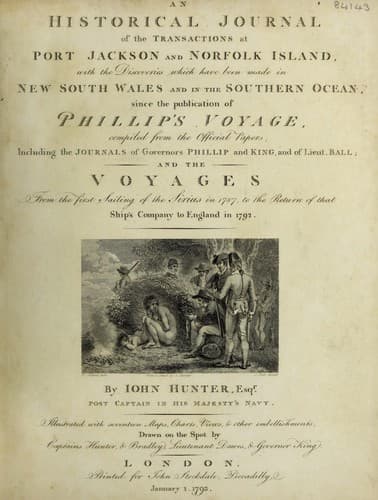
An Historical Journal of the Transactions at Port Jackson and Norfolk IslandHunter, John
History
An Historical Journal of the Transactions at Port Jackson and Norfolk Island
Hunter, John
New South Wales -- History -- Sources
From this time till the 22d, we had variable weather, the wind
in general from the south-east. Lieutenant Ball was directed to
call at Norfolk-Island, if it did not occasion him too much loss
of time; but, as the winds seemed to hang to the eastward, there
was every probability of losing at least a fortnight; and, as the
Supply did not carry any thing which could be of the least
assistance to those on the island, he thought proper to proceed
on the voyage, and accordingly bore up in order to go to the
westward of the shoal seen by the Golden-Grove, in latitude
29 deg. 25' south, and 159 deg. 59' east longitude: Lieutenant
Shortland also saw another shoal, as hath already been mentioned,
which may probably be the same, if they exist: this, however,
seems to be a matter of doubt, as Lieutenant Ball, in July, 1789,
cruized in these and the adjacent latitudes and longitudes for a
fortnight, and could not see the least appearance either of an
island or shoals; although Mr. Blackburn, the master of the
Supply, who was at that time on board the Golden-Grove, is very
confident that a shoal was seen in that vessel.
We had very heavy gales of wind from east until the 28th, with
violent squalls, attended with rain: the air in general thick and
hazy, and a high hollow sea running. At one o'clock on the 28th,
we perceived a great alteration in the sea, which was become so
smooth, that at four o'clock it was, comparatively speaking,
smooth water: at half past five, the man who was stationed at the
mast-head, saw breakers in the south-east, which were found to be
a shoal, bearing from south-east by east to east-south-east,
about seven miles distant: it appeared to trend south-south-east
and north-north-west; and the north end seemed to break off
suddenly in a small bluff.
The man at the mast-head had seen this shoal a considerable
time before he spoke of it, and, when asked why he did not
mention it sooner, he said that he took it for the reflection of
the setting-sun; forgetting that the sun, if it had been visible,
set to the westward: this circumstance occasioned Lieutenant Ball
to name it "-Booby shoal:-" its latitude is 21 deg. 24'
south, and the longitude, by the time-keeper, 159 deg. 24' east
of Greenwich. Immediately after passing this shoal, we found the
same high hollow sea running as we had in the morning.
Public-domain text, read in full here on John Shaqi.
Reviews
Reviews
No reviews yet
Be the first to share your thoughts on this work.
Elsewhere in the archive
Join the Discussion
Join the discussion
Sign in to leave a comment or review.
Sign InorCreate an account