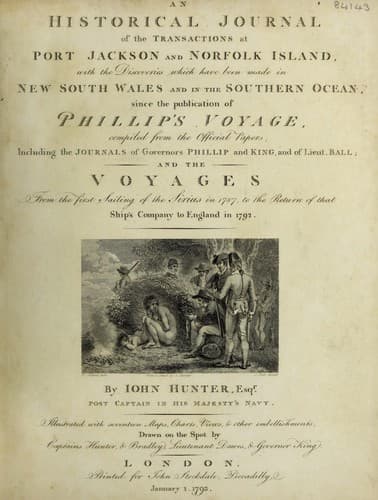
An Historical Journal of the Transactions at Port Jackson and Norfolk IslandHunter, John
History
An Historical Journal of the Transactions at Port Jackson and Norfolk Island
Hunter, John
New South Wales -- History -- Sources
This land in general is very high, and appears well wooded:
there is the appearance of a number of openings, resembling bays
or harbours; but our distance from shore was too great to
ascertain any observation of that kind. At noon our latitude was
9 deg. 00' south, and the longitude 161 deg. 41' east; and the
land trending away to the north-west, it was evident that we had
rounded the east part of that island which Lieutenant Shortland
coasted on its south side, from the latitude of 10 deg. 44' south
longitude 161 deg. 41' east, to 6 deg. 55' south latitude, and
156 deg. 30' east longitude.
As Lieutenant Shortland made the land on the opposite side of
this island in latitude 10 deg. 44' south, longitude 161 deg. 30'
east, and the Supply being this day in latitude 9 deg. 00' south,
longitude 161 deg. 41' east; there remains a space between the
situation of the two vessels, which, reduced to bearings and
distances from these latitudes and longitudes, will give south
6 deg. east; distance 104 miles: now, the Supply was ten leagues
off shore, and, admitting the Alexander (Lieutenant Shortland's
ship,) to have been four leagues, it will make the breadth of the
island 62 miles, and its length and bearings will be south
57 deg. east, and north 57 deg. west, 436 miles.
The eastern extremity of this land is an island about 18 miles
in circuit, lying at a small distance from the main island: I
have before observed that it was named Sirius-Island, between
which, and the Queen Charlotte's Islands, there cannot be many
leagues, supposing Captain Carteret's longitude to have been
right.
The north-east coast of this island Lieutenant Ball named
"-Ball's Maiden Land_;" and the passage between Sirius and
Queen Charlotte's Islands, "-Supply's Passage_."
At day-light in the morning of the 9th, land was seen, bearing
from south to west, eleven leagues distant; it was very high, and
there appeared to be a number of openings in it. Our latitude at
noon on the 10th, was 7 deg. 16' south, and the longitude
162 deg. 23' east. We now daily found the vessel set considerably
to the northward and westward, and on the 16th she was set 48
miles west-north-west during the 24 hours.
A different kind of sea-fowl was seen about the vessel to any
we had hitherto met with; it was of the ganet kind; the back,
wings, and head being a glossy black, and the breast entirely
white.
Public-domain text, read in full here on John Shaqi.
Reviews
Reviews
No reviews yet
Be the first to share your thoughts on this work.
Elsewhere in the archive
Join the Discussion
Join the discussion
Sign in to leave a comment or review.
Sign InorCreate an account