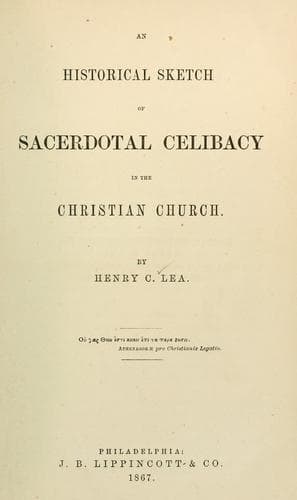
An Historical Sketch of Sacerdotal Celibacy in the Christian ChurchLea, Henry Charles
History
An Historical Sketch of Sacerdotal Celibacy in the Christian Church
Lea, Henry Charles
Catholic Church -- Clergy; Celibacy -- Catholic Church; Church history
Denis, it was resolved
to open Charles’s tomb. The only tenant of the sepulchre was found to
be a serpent, and the walls were blackened as though by fire, thus
proving the truth of the revelation, and holding out an awful warning
to future wrongdoers.[287]
How much of the license complained of was indiscriminate concubinage,
and how much was merely intercourse with legitimate wives, we have no
means of ascertaining. The latter Boniface succeeded in suppressing,
for the church could control her sacraments.[288] The former was beyond
his power.
Armed with full authority from Pope Zachary, Carloman and Boniface
commenced the labor of reducing to order this chaos of passion and
license. Under their auspices a synod was held, April 23, 742, in
which all unchaste priests and deacons were declared incapable of
holding benefices, were degraded and forced to do penance. Bishops were
required to have a witness to testify to the purity of their lives and
doctrines, before they could perform their episcopal functions. For
all future lapses from virtue, priests were to be severely whipped and
imprisoned for two years on bread and water, with prolongation of the
punishment at the discretion of their bishops. Other ecclesiastics,
monks, and nuns were to be whipped thrice and similarly imprisoned
for one year, besides the stigma of having the head shaved. All
monasteries, moreover, were to adopt and follow rigidly the rule of St.
Benedict.[289]
The stringency of these measures shows not only the extent of the
evil requiring such means of cure, but the fixed determination of
the authorities to effect their purpose. The clergy, however, did
not submit without resistance. It is probable that they stirred up
the people, and that signs of general disapprobation were manifested
at a rigor so extreme in punishing faults which for more than two
generations had passed wholly unnoticed, for during the same year
Zachary addressed an epistle to the Franks with the object of enlisting
them in the cause. The ill-success of their arms against the Pagans
he attributes to the vices of their clergy, and he promises them
that if they show themselves obedient to Boniface, and if they can
enjoy the prayers of pure and holy priests, they shall in future have
an easy triumph over their heathen foes.[290] Yet many adulterous
priests and bishops, noted for the infamy of their lives, pretended
that they had received from Rome itself dispensations to continue in
their ministry—an allegation which Zachary of course repelled with
indignation.[291]
Carloman, however, pursued his self-imposed task without flinching. On
March 1st, 743, he held another synod at Leptines, where the clergy
promised to observe the ancient canons, and to restore the discipline
of the church. The statutes enacted the previous year were again
declared to be in full vigor for future offences, while for previous
ones penitence and degradation were once more decreed.[292]
Public-domain text, read in full here on John Shaqi.
Reviews
Reviews
No reviews yet
Be the first to share your thoughts on this work.
Elsewhere in the archive
Join the Discussion
Join the discussion
Sign in to leave a comment or review.
Sign InorCreate an account