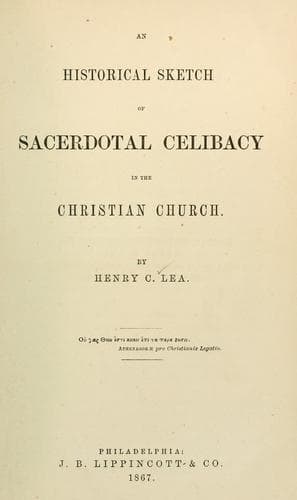
An Historical Sketch of Sacerdotal Celibacy in the Christian ChurchLea, Henry Charles
History
An Historical Sketch of Sacerdotal Celibacy in the Christian Church
Lea, Henry Charles
Catholic Church -- Clergy; Celibacy -- Catholic Church; Church history
The new pope, Nicholas II. by name, entered unreservedly into their
views. Apparently taught by experience the fruitlessness of additional
legislation when the existing canons were amply sufficient, but
their execution impossible through the negligence or collusion of
the ecclesiastical authorities, he assembled, in 1059, a council of
a hundred and thirteen bishops, in which he adopted the novel and
hazardous expedient of appealing to the laity, and of rendering them
at once the judges and executioners of their pastors. A canon was
promulgated forbidding all Christians to be present at the mass of
any priest known to keep a concubine or female in his house.[475]
This probably remained, like its predecessors, a dead letter for the
present, but we shall see what confusion it excited when it was revived
and put effectually in force by Gregory VII. some fifteen years later.
Meanwhile I may observe that it trenched very nearly on the Donatist
heresy that the sacrament was polluted in polluted hands, and it
required the most careful word-splitting to prevent the faithful from
drawing a conclusion so natural.[476]
In addition to this, the council ordered, under pain of
excommunication, that no priest who openly took a concubine (or
rather a wife), or who did not forthwith separate himself from such
a connection already existing, should dare to perform any sacred
function, or enjoy any portion of ecclesiastical revenue.[477]
Hildebrand, who was all-powerful at the papal court—his enemies accused
him of keeping Nicholas like an ass in the stable, feeding him to do
his work—has the credit of procuring this legislation.[478] Nicholas,
whether acting under the impulsion of Hildebrand and Damiani, or from
his own convictions, followed up the reform with vigor. During the same
year he visited Southern Italy, and by his decided proceedings at the
council of Melfi endeavored to put an end to the sacerdotal marriages
which were openly practised everywhere throughout that region, and the
Bishop of Trani was deposed as an example and warning to others.[479]
Damiani was also intrusted with a mission to Milan for the same
purpose, of which more anon.
Nor did Nicholas confine his efforts to Italy. His legates in other
countries endeavored to enforce the canons, and apparently had little
difficulty in obtaining the adoption of stringent regulations—the more
easily acceded to that they were utterly disregarded. Thus his legate
Stephen, early in 1060, held councils at Vienne and Tours, where the
prohibitions of the synod of Rome were agreed to, and those who did not
at once abandon either their women or their benefices were declared to
be degraded forever, without hope of restitution.[480]
Public-domain text, read in full here on John Shaqi.
Reviews
Reviews
No reviews yet
Be the first to share your thoughts on this work.
Elsewhere in the archive
Join the Discussion
Join the discussion
Sign in to leave a comment or review.
Sign InorCreate an account