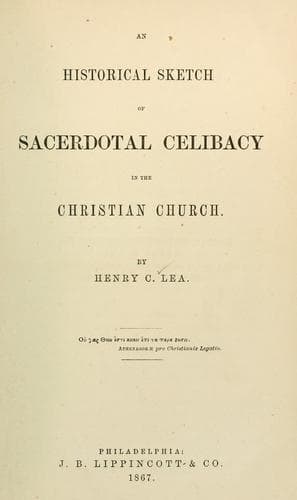
An Historical Sketch of Sacerdotal Celibacy in the Christian ChurchLea, Henry Charles
History
An Historical Sketch of Sacerdotal Celibacy in the Christian Church
Lea, Henry Charles
Catholic Church -- Clergy; Celibacy -- Catholic Church; Church history
of Damiani at the altar, their faithful observance of the pledge to
destroy the simoniacal and Nicolitan heresies, under penalties the
most tremendous; and Guido prostrating himself on the ground, humbly
deplored his negligence in the past, imposed on himself a penitence of
a hundred years (redeemable at a certain sum per annum), and vowed a
pilgrimage to Santiago de Compostella to atone for his sin. Not content
with this, Damiani mounted the pulpit and made both priests and people
take an oath to extirpate both heresies; and the clergy, before being
reconciled to the church and restored to the positions which they had
forfeited by their contumacy, were forced individually under oath to
anathematize all heresies, and especially those of simony and marriage.
A penance was imposed on every one involved in simony—no allusion being
made to those who were married; some, who were manifestly unfit for
their sacred duties, were suspended, and the legates returned, after
triumphantly accomplishing the objects of their mission.[513]
If Damiani fancied that argumentative subtlety and paper promises,
even though solemnly given in the name of God and all his saints,
were to settle a question involving the fiercest passions of men,
the cloistered saint knew little of human nature. The pride of the
Milanese was deeply wounded by a subjection to Rome, unknown for many
generations, and ill endured by men who gloried in the ancient dignity
of the Ambrosian church. When, therefore, in 1061, their townsman,
Anselmo di Badagio, was elevated from the episcopate of Lucca to that
of the Holy See, Milan, in common with the rest of Lombardy, eagerly
embraced the cause of the anti-pope Cadalus. One of Anselmo’s earliest
acts as pope was to address a letter to the Milanese, affectionately
exhorting them to amendment, and expressing a hope that his pontificate
was to witness the extinction of the heresies which had distracted
and degraded the church.[514] He could scarcely have entertained
the confidence which he expressed, for though Landolfo and Arialdo
endeavored, with unabated zeal, to enforce the canons, the Nicolitan
faction, regardless of the pledges given to Damiani, maintained the
contest with equal stubbornness. Landolfo, on a mission to Rome, was
attacked at Piacenza, wounded, and forced to return. Soon after this he
was prostrated by a pulmonary affection, lost his voice, and died after
a lingering illness of two years.[515] The Paterins, thus deprived of
their leader, found another in the person of his brother, Erlembaldo,
just then returned from a pilgrimage to the Holy Land. Gifted with
every knightly accomplishment, valiant in war, sagacious in council, of
a commanding presence, and endowed with eloquence to sway the passions
of the multitude, he was the impersonation of a popular leader;
while, in the cause to which he was now called, his deep religious
convictions lent an attraction which was heightened by an unpardonable
Public-domain text, read in full here on John Shaqi.
Reviews
Reviews
No reviews yet
Be the first to share your thoughts on this work.
Elsewhere in the archive
Join the Discussion
Join the discussion
Sign in to leave a comment or review.
Sign InorCreate an account