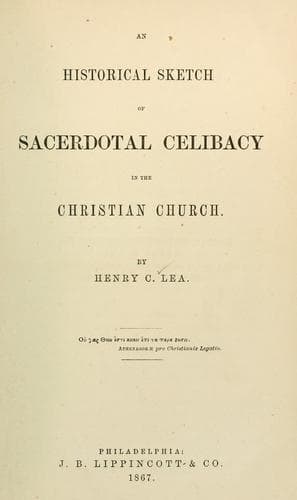
An Historical Sketch of Sacerdotal Celibacy in the Christian ChurchLea, Henry Charles
History
An Historical Sketch of Sacerdotal Celibacy in the Christian Church
Lea, Henry Charles
Catholic Church -- Clergy; Celibacy -- Catholic Church; Church history
Yet at last the question of sacerdotal marriage sank out of sight when
the civil broils of Milan merged into the European quarrel between the
empire and papacy. When, in 1093, Henry IV. was driven out of Italy
by the revolt of his son Conrad, and the latter was created King of
Lombardy by Urban II. and the Countess Matilda, the dependence of the
young king upon the pope rendered impossible any further open defiance
of the laws of the church, and public marriage there, as elsewhere,
was doubtless replaced by secret immorality.[527] The triumph of the
sacerdotal party was consummated at the great council of Piacenza,
held by Urban II. in February, 1095, to which prelates flocked from
every part of Europe, and the people gathered in immense numbers. If,
as the chronicler informs us, four thousand ecclesiastics and thirty
thousand laymen assembled on the occasion, and the sessions were held
in the open air because no building could contain the thronging masses,
we may reasonably attribute so unprecedented an assemblage to the wild
religious ardor which was about to culminate in the first Crusade.
That council condemned Nicolitism in the most absolute and peremptory
manner, and there is no reason to believe that the power of so
formidable a demonstration was lightly disregarded.[528] Yet in Milan,
as we shall see elsewhere throughout Europe, the custom of sacerdotal
marriage had become so thoroughly established that it could not be
eradicated suddenly. It continued to survive stubbornly after every
attempt at repression with more or less openness as the persecution of
married priests was more or less severe. A synod held in Milan in 1098
is discreetly silent as to wedlock or concubinage among ecclesiastics,
though it is severe upon the concurrent vice of simony, and though its
prohibition of hereditary succession in church benefices and dignities
would show that marriage among their incumbents must have been by no
means infrequent. Moreover, even as late as 1152, Mainerio Boccardo, a
canon of Monza, in his will specifies that certain provisions for the
benefit of his brother canons shall not be enjoyed by those who are
married, thus proving that the Hildebrandine reforms had not yet been
successful, though Rome had long since attained its object in breaking
down the independence of the Ambrosian church.[529]
* * * * *
Public-domain text, read in full here on John Shaqi.
Reviews
Reviews
No reviews yet
Be the first to share your thoughts on this work.
Elsewhere in the archive
Join the Discussion
Join the discussion
Sign in to leave a comment or review.
Sign InorCreate an account