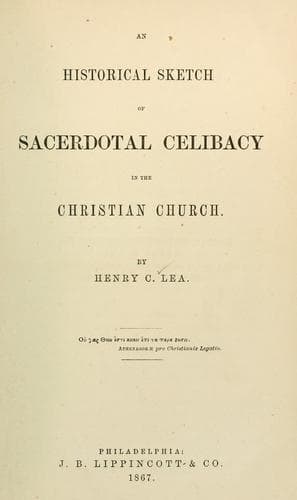
An Historical Sketch of Sacerdotal Celibacy in the Christian ChurchLea, Henry Charles
History
An Historical Sketch of Sacerdotal Celibacy in the Christian Church
Lea, Henry Charles
Catholic Church -- Clergy; Celibacy -- Catholic Church; Church history
His first movement on the subject appears to have been an epistle
addressed in November, 1073, to Gebhardt Archbishop of Salzburg,
taking him severely to task for his neglect in enforcing the canons
promulgated not long before in Rome, and ordering him to carry them
rigidly into effect among his clergy.[536] This, no doubt, was a
circular letter addressed to all the prelates of Christendom, and it
was but a preliminary step. Early in Lent of the next year (March,
1074), he held his first synod, which adopted a canon prohibiting
sacerdotal marriage, ordering that no one in future should be admitted
to orders without a vow of celibacy, and renewing the legislation of
Nicholas II. which commanded the people not to attend the ministrations
of those whose lives were a violation of the rule.[537] There was
nothing in the terms of this more severe than what had been decreed in
innumerable previous councils—indeed, it was by no means as threatening
as many decretals of recent date; but Gregory was resolved that it
should not remain, like them, a mere protest, and he took immediate
measures to have it enforced wherever the authority of Rome extended.
The controversy as respects Italy has already been so fully described
that to dilate upon it further would be superfluous. Even though
Alexander II. in his later years had shrunk somewhat from the contest,
yet from Naples to the Tyrol the question was thoroughly understood,
and its results depended more upon political revolutions than on
ecclesiastical exertions. Beyond the Alps, however, the efforts of
preceding popes had thus far proved wholly nugatory, and on this field
Gregory now bent all his energies. The new canon was sent to all the
bishops of Europe, with instructions to promulgate it throughout their
respective dioceses, and to see that it was strictly obeyed; while
legates were sent in every direction to support these commands with
their personal supervision and exertion.[538]
Public-domain text, read in full here on John Shaqi.
Reviews
Reviews
No reviews yet
Be the first to share your thoughts on this work.
Elsewhere in the archive
Join the Discussion
Join the discussion
Sign in to leave a comment or review.
Sign InorCreate an account