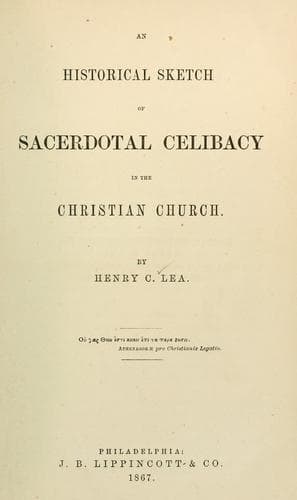
An Historical Sketch of Sacerdotal Celibacy in the Christian ChurchLea, Henry Charles
History
An Historical Sketch of Sacerdotal Celibacy in the Christian Church
Lea, Henry Charles
Catholic Church -- Clergy; Celibacy -- Catholic Church; Church history
If the reformatory efforts of the popes had not penetrated into the
kingdom of Edward the Confessor, it was hardly to be expected that
they would excite attention amid the turmoil attendant upon the
settlement of the new order of political affairs and the division of
the spoils among the conquerors. Accordingly, even the vigilance of
Gregory VII. appears to have virtually overlooked the distant land of
Britain, conscious, no doubt, that his efforts would be vain, even
though the influence of Rome had been freely thrown upon the side of
the Norman invader, and had been of no little assistance to him in his
preparations for the desperate enterprise. In fact, though William saw
fit to aid in the suppression of matrimony among the priests of his
hereditary dominions, and had thereby earned the grateful praises of
Gregory himself,[660] he does not seem to have regarded the morals of
his new subjects as worthy of any special attention. It is true that in
his system of transferring all power from the subject to the dominant
race, when Saxon bishops were to be ejected and their places filled
with his own creatures, it was necessary for him to effect his purpose
in a canonical way, and to procure the degradation of his victims
by the church itself, as it was impossible for him to lay unhallowed
hands upon their consecrated heads, or to remove prelates from their
sees on questions of mere political expediency. To accomplish this,
the scandals and irregularities of their lives afforded the promptest
and most effective excuse, and it was freely used. The vigor with
which these changes were carried into effect is visible in the synods
of Winchester and Windsor in 1070, where numerous bishops and abbots
were deprived on various pleas; and the character of the prelates
removed may be assumed from the description of the Bishop of Litchfield
(Chester) by Lanfranc, in a letter of the same year to Alexander
II., where his public maintenance of wife and children is alleged,
in addition to other crimes of which he was accused.[661] Though a
puritan, like Lanfranc, bred in the asceticism of the Abbey of Bec,
might seek to enforce the canons in an individual case, as when he
orders Arfastus, Bishop of Thetford, to degrade a deacon who refused
to part with his wife,[662] yet that no general effort was made to
effect a reform in the ranks of the clergy is evident from an epistle
addressed in 1071 to William by Alexander II., in which, while praising
his zeal in suppressing the heresy of simony, and exhorting him to
fresh exertion in the good work, no mention whatever is made of the
kindred error of Nicolitism, which is usually inseparable in the papal
diatribes of the period.[663] Equally conclusive is the fact that when,
in 1075, Lanfranc held a national council in London for the purpose of
reforming the English church, canons were passed to restrain simony,
to prevent incestuous marriages, and to effect other needful changes,
Public-domain text, read in full here on John Shaqi.
Reviews
Reviews
No reviews yet
Be the first to share your thoughts on this work.
Elsewhere in the archive
Join the Discussion
Join the discussion
Sign in to leave a comment or review.
Sign InorCreate an account