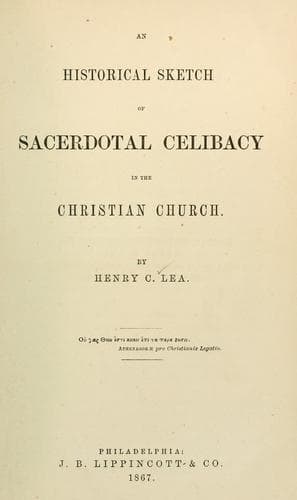
An Historical Sketch of Sacerdotal Celibacy in the Christian ChurchLea, Henry Charles
History
An Historical Sketch of Sacerdotal Celibacy in the Christian Church
Lea, Henry Charles
Catholic Church -- Clergy; Celibacy -- Catholic Church; Church history
One symptom of weakness is observable in all this. The council
apparently did not venture to prescribe any ecclesiastical punishment
for the infraction of the rules thus laid down. If this arose from
timidity, St. Anselm did not share it, for, when he proceeded to put
the canons in practice, we find him threatening his contumacious
ecclesiastics with deprivation for persistence in their irregularities.
A letter of instruction from him to William, Archdeacon of Canterbury,
shows the earnestness with which he entered upon the reform, and also
affords an instructive insight into the difficulties of the enterprise,
and the misery which the forcible sundering of family ties caused
among those who had never doubted the legality and propriety of their
marriages. Some ecclesiastics of rank sent their discarded wives to
manors at a distance from their dwellings, and these St. Anselm directs
shall not be molested if they will promise to hold no intercourse
except in the presence of legitimate witnesses. Some priests were
afraid to proceed to extremities with their wives, and for these weak
brethren grace is accorded until the approaching Lent, provided they
do not attempt meanwhile to perform their sacred functions, and can
find substitutes of undoubted chastity to minister in their places. The
kindred of the unfortunate women apparently endeavored to avert the
blow by furious menaces against those who should render obedience,
and these instigators of evil are to be restrained by threats of
excommunication.[669] Another letter to the Bishop of Hereford, who
had applied for instructions on the subject, directs him to replace
recalcitrant priests with monks and to stir up the laity to drive from
the land the obstinate parsons and their wives.[670] In the enforcement
of these reforms he seemed to meet with questions for which he was not
prepared, for about this time we find him seeking instructions from
Paschal II. on several knotty points: whether a priest living with his
wife can be allowed to administer the viaticum at the death-bed in the
absence of one professing continence; and what is to be done with him
if he refuses his ministration on the ground that he is not allowed to
celebrate mass. Paschal replies, sensibly enough, that it is better to
have the ministrations of an unchaste priest than to die unhouselled,
and that a priest refusing his offices under such circumstances is to
be punished as a homicide of souls. This abandoned the Hildebrandine
theory and practice, and Anselm was more consistent when he assumed
that a layman could perform baptism in preference to an unchaste
priest.[671]
Public-domain text, read in full here on John Shaqi.
Reviews
Reviews
No reviews yet
Be the first to share your thoughts on this work.
Elsewhere in the archive
Join the Discussion
Join the discussion
Sign in to leave a comment or review.
Sign InorCreate an account