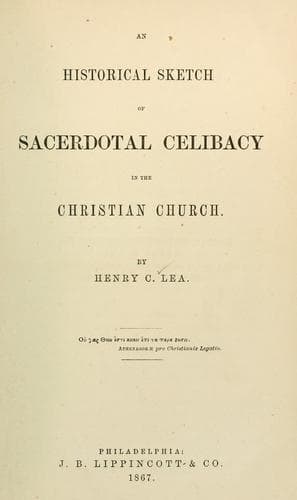
An Historical Sketch of Sacerdotal Celibacy in the Christian ChurchLea, Henry Charles
History
An Historical Sketch of Sacerdotal Celibacy in the Christian Church
Lea, Henry Charles
Catholic Church -- Clergy; Celibacy -- Catholic Church; Church history
The example which King John had set, however instructive, was not
appreciated by the ecclesiastical authorities, and the “focariæ” were
allowed to remain virtually undisturbed, at least to such an extent as
to render them almost universal. Although by rigid churchmen they were
regarded as mere concubines, there can be little doubt that the tie
between them and the priests was of a binding nature, which appears to
have wanted none of the rites essential to its entire respectability.
Giraldus Cambrensis, who died at an advanced age about the year 1220,
speaks of these companions being publicly maintained by nearly all
the parish priests in England and Wales. They arranged to have their
benefices transmitted to their sons, while their daughters were
married to the sons of other priests, thus establishing an hereditary
sacerdotal caste in which marriage appears to have been a matter of
course.[698] In 1202 the Bishop of Exeter complained to Innocent III.
of the numerous sons of parish priests and vicars who seized their
churches and claimed to hold them of right, actually appealing to Rome
when he sought to interfere with them. Innocent of course ordered
their removal and subjection to discipline without appeal: but the
evil continued, and in 1205 we find him writing on the subject to the
Bishop of Winchester whom he required to eject the sons of priests
who in many cases held their father’s benefices.[699] The propriety
of the connection, and the hereditary ecclesiastical functions of the
offspring are quaintly alluded to in a poem of the period, wherein a
logician takes a priest to task for entertaining such a partner—
L.—Et præ tot innumeris quæ frequentas malis,
Est tibi presbytera plus exitialis.
P.—Malo cum presbytera pulchra fornicari,
Servituros domino filios lucrari,
Quam vagas satellites per antra sectari:
Est inhonestissimum sic dehonestari.[700]
Even the holy virgins, spouses of Christ, seem to have claimed and
enjoyed the largest liberty. To this period is attributed a homily
addressed to nuns, which earnestly dissuades them from leaving
their blessed state and subjecting themselves to the cares and
toils inseparable from matrimony. The writer appeals to no rules
of ecclesiastical law that could be enforced to prevent them from
following their choice, but labors drearily to prove that they would
not better their condition, either in this world or the next, by
forsaking their heavenly bridegroom for an earthly one.—“And of godes
brude. and his freo dohter. for ba to gederes ha is; bicumeth theow
under mon and his threl to don al and drehen that him liketh.”[701]
* * * * *
Public-domain text, read in full here on John Shaqi.
Reviews
Reviews
No reviews yet
Be the first to share your thoughts on this work.
Elsewhere in the archive
Join the Discussion
Join the discussion
Sign in to leave a comment or review.
Sign InorCreate an account