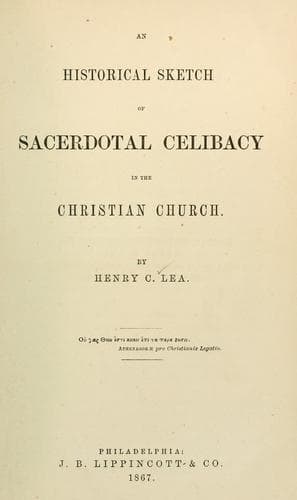
An Historical Sketch of Sacerdotal Celibacy in the Christian ChurchLea, Henry Charles
History
An Historical Sketch of Sacerdotal Celibacy in the Christian Church
Lea, Henry Charles
Catholic Church -- Clergy; Celibacy -- Catholic Church; Church history
Flanders, and that the d’Avesnes were legitimate, which judgment was
confirmed by Innocent himself in 1252. Thus fortified, Jean d’Avesnes
resisted the proposed partition, and a bloody civil war arose. The
victory of Vacheren placed the Dampierre in the hands of their
half-brothers, and promised to be decisive, until Margaret called in
Charles de Valois, bribing him with the offer of Hainault to complete
the disinheriting of her first-born. The war continued until Louis,
returning from the East in 1255, compelled the combatants to lay down
their arms, and to abide by his arbitration.[811]
In this case we see Innocent III. deciding that marriage was
incompatible with the subdiaconate. Yet it is a striking illustration
of the uncertainty which still surrounded the matter to find the
same pope, in 1208, commanding a subdeacon of Laon to return to the
wife whom he had abandoned on taking orders, and to treat her in all
respects as a wife. Innocent is not to be suspected of any temporizing
concession to prevailing laxity, and yet in this case he overruled the
uninterrupted tradition of the canons that married men taking orders
should thenceforth treat their wives as sisters; and the doubts which
experienced ecclesiastics entertained with regard to the law are
visible in the fact that when the wife complained of her abandonment
to the metropolitan authorities at Rheims they did not pretend to give
judgment, but sent the testimony in the case at once to Innocent for
his decision.[812]
Another curious case occurring about the same time illustrates the
complexity of the questions which arose and the manner in which the
selfishness of ascetic zeal sometimes eluded even the very slender
barriers with which the church limited its gratification. As we have
seen, it was an ancient rule that no man could assume monastic vows
without the assent of his wife, with the additional condition that
she must at the same time enter a nunnery. It appears that a husband
desiring to become a monk, and finding his wife obstinately opposed
to his designs, enlisted the services of various priests to influence
her, carefully concealing from her the obligation which her assent
would impose upon her to take the veil. Still she obstinately refused,
until at last he threatened to castrate himself, when she yielded
and went through the ceremony of placing with her own hands his head
on the altar. The wife thus abandoned took to evil courses, and the
husband-monk applied in person to Innocent III. to learn whether he
ought to remain in his order, seeing that his continence might be
responsible for her unchastity. In spite of the deceit practised upon
the wife, Innocent resolved his doubts in favor of the maintenance of
his vows, giving as a reason that her adulteries deprived her of claim
on him. At the same time, nothing was said as to compelling the woman
to take the veil.[813]
* * * * *
Public-domain text, read in full here on John Shaqi.
Reviews
Reviews
No reviews yet
Be the first to share your thoughts on this work.
Elsewhere in the archive
Join the Discussion
Join the discussion
Sign in to leave a comment or review.
Sign InorCreate an account